


How to Prevent Burnout in the Hospitality Industry: 5 Warning Signs
The most effective way to prevent burnout in the hospitality industry is to proactively monitor your team for widespread guest complaints, sudden employee disengagement, and rising absenteeism. By recognizing these warning signs early, hotel leaders can adjust operational workflows and secure workforce support before a staffing crisis occurs.
Summer is supposed to be the most profitable season of the year for hotels. High occupancy rates, packed event calendars, and buzzing rooftop bars should ideally translate to a thriving bottom line.
However, for many hotel owners and general managers, June marks the beginning of severe operational exhaustion. Behind the scenes, frontline staff are frequently stretched beyond their physical and psychological limits. If you fail to recognize the early indicators of employee exhaustion, it will trigger a destructive domino effect on your revenue.
📌 Key Takeaways
Monitor top performers closely: Your most reliable employees are usually the first to suffer from emotional exhaustion.
Track complaint patterns: A sudden, coordinated spike in guest complaints across multiple departments indicates a systemic staffing issue.
Watch for absenteeism: Sudden spikes in call-offs and tardiness are physical manifestations of workplace stress.
Protect leadership bandwidth: General managers and department heads need operational relief to avoid severe decision fatigue.
Partner for scale: Use professional hospitality workforce solutions to scale labor dynamically with occupancy spikes.
Table of Contents
Why Summer Exhaustion Hits Hotels Harder
5 Critical Burnout Warning Signs Hotel Leaders Must Monitor
The Hidden Financial Cost of Ignoring Workforce Exhaustion
Why DIY Hotel Staffing Solutions Frequently Fail
Implementing Professional Hospitality Workforce Support
Frequently Asked Questions (FAQ)
Quick Answer: Hotels cannot scale back service hours during peak seasons like corporate offices can. The immense disparity between soaring guest expectations and dwindling operational capacity creates an environment of intense, sustained pressure.
Unlike corporate or tech environments, hotels cannot implement “summer Fridays.” When occupancy spikes, service expectations remain stubbornly high.
Guests paying premium peak-season rates expect a seamless, luxurious experience. They do not care if your housekeeping department is short-staffed by 30%. They do not care if your front desk agents just worked six consecutive twelve-hour shifts.
The Cycle of Emotional Exhaustion
This disparity creates severe emotional labor. Hospitality exhaustion is far more dangerous than simple physical fatigue. It is a state of mental and operational depletion that systematically erodes employee performance.
| Trigger | Reaction | Result |
| Peak Occupancy | Surging Guest Demands | Zero downtime for staff |
| Open Shifts | Extended Overtime | Physical & emotional fatigue |
| No Interventions | Severe Emotional Labor | Systemic Employee Burnout |
What makes this exceptionally perilous is how quietly it develops. Many hospitality professionals continue showing up long after they have emotionally checked out. Beneath the surface, service quality and collective morale are already deteriorating.

Quick Answer: Hotel leaders must watch for five distinct red flags: synchronized guest complaints, the withdrawal of high-performing staff, spiking absenteeism, interdepartmental friction, and signs of leadership fatigue.
To protect your property’s reputation and operational integrity this summer, you must remain vigilant. Watch closely for these five critical warning signs within your departments.
1. Guest Complaints Rise Across Multiple Departments
One isolated guest complaint regarding a slow check-in is a standard operational variance. However, a sudden, synchronized pattern of complaints across several distinct departments is a clear indicator of systemic fatigue.
When burnout spreads through a property, you will notice friction points involving:
Front Office: Unusually slow check-in lines and registration errors.
Housekeeping: Delayed room readiness and missed cleaning standards.
Food & Beverage: Extended table wait times and visibly frazzled banquet staff.
Engineering: Escalated response times for in-room maintenance requests.
💡 Expert Insight: “Burned-out employees stop executing the proactive micro-moments that define luxury service. Instead, they shift into a purely reactive survival mode, aiming only to finish the shift without a guest escalation.”
This creates a direct line between employee wellbeing and your hotel’s online reputation. Drops in Google ratings, TripAdvisor rankings, and internal guest satisfaction scores (CSAT) directly impact your revenue.
2. Your Best Employees Suddenly Disengage
A common, costly mistake hotel leaders make is assuming that exhaustion primarily targets underperforming employees. In reality, the exact opposite is true.
Your strongest top performers are always the first to break. They are the reliable anchors who consistently carry the operational weight of the property. They stay late, solve complex guest escalations, and cover unexpected scheduling gaps.
Over time, this disproportionate reliance becomes completely unsustainable.
⚠️ Common Mistake: Never assume a quiet high-performer is a happy high-performer. Quiet compliance often masks deep emotional withdrawal and impending resignation.
Look for subtle signs of psychological withdrawal. Are they delivering transactional service rather than genuine connection? Have they stopped volunteering for projects? By the time a top performer hands in their two-week notice in July, the operational damage is done.
3. Absenteeism and Call-Offs Escalate
Workplace exhaustion eventually manifests as physical illness. When mental and emotional stress are ignored long enough, the human body forces a break.
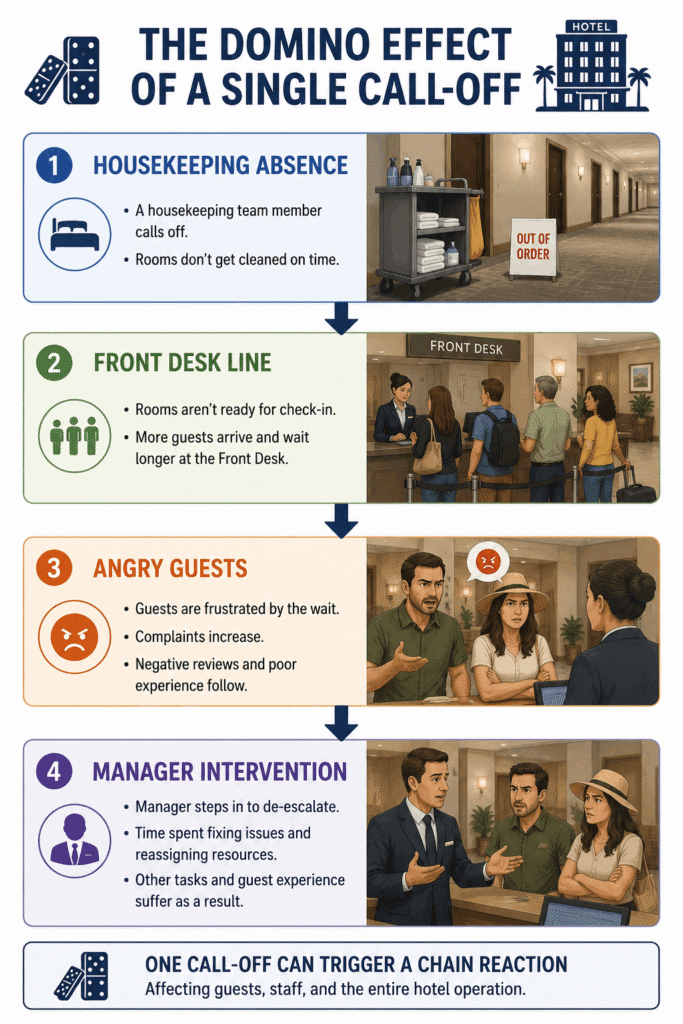
If your HR dashboard shows a sudden spike in last-minute call-offs, chronic tardiness, or constant requests for shift swaps, your team is sending an SOS. In a tightly integrated hotel ecosystem, absenteeism triggers a vicious domino effect.
A single housekeeping call-off delays room readiness. This creates a front desk backlog, resulting in upset guests lingering in the lobby. Eventually, managers must step in to clean rooms, accelerating leadership fatigue.
4. Interdepartmental Friction Becomes Normal
A healthy hotel operates like a finely tuned orchestra. It requires seamless communication between the Front Office, Housekeeping, and Food & Beverage. When emotional exhaustion sets in, individual patience wears thin.
Keep a close eye on behavioral shifts in back-of-house areas and manager meetings. Watch for these burnout-fueled cultural friction points:
Departmental Siloing: Front Desk blaming Housekeeping for late check-ins.
Shift-Change Friction: Morning shifts leaving uncompleted tasks for the evening crew.
Defensive Communication: Staff responding to basic operational requests with hostility.
Chronic stress actively impairs the brain’s capacity for empathy and emotional regulation. A hotel staffed by an exhausted, combative team feels cold, rushed, and profoundly un-welcoming to guests.
5. Managers and Department Heads Are Exhausted
Leadership fatigue is one of the most neglected threats in the entire hotel sector. Property leaders frequently act as shock absorbers. They attempt to buffer their front-line teams from corporate pressures.
During peak summer demand, hotel managers frequently work 14-hour days. They sacrifice their days off to cover line-level gaps and handle intense service recoveries.
This sustained operational pressure leads to a critical state of decision fatigue. Managers may delay critical operational approvals or react punitively to minor staff mistakes. When leadership falters, the property loses its strategic compass. To prevent this, explore [leadership development programs] to build resilient management teams.
Quick Answer: Ignoring employee fatigue results in massive financial losses through constant recruitment costs, expensive guest service recoveries (comped rooms), and an increase in costly workers’ compensation claims.
Some traditional hotel operators still treat summer fatigue as an unavoidable rite of passage. That outdated perspective is incredibly expensive.
Ignoring workforce exhaustion impacts multiple areas of your profit and loss (P&L) statement. First, there is the true cost of employee turnover. Replacing a single line-level worker costs thousands in direct recruiting and onboarding expenses.
📊 Data Point: According to research published by the Cornell University Center for Hospitality Research, the average cost of turning over a single frontline hospitality employee exceeds $5,800.
Furthermore, frazzled staff make mistakes. This results in compensated meals, comped room nights, and waived resort fees to appease angry guests. Properties struggling with severe burnout also consistently see an uptick in back-of-house accidents, driving up insurance premiums.
Quick Answer: Internal, reactive strategies like enforcing mandatory overtime or rushing unvetted emergency hires often backfire. These tactics increase operational mistakes, dilute brand standards, and deepen resentment among core staff.
When faced with summer labor shortages, many hotel leaders reflexively resort to internal, reactive operational strategies. While well-intentioned, these “Do-It-Yourself” interventions often exacerbate the problem.
The Pitfalls of Mandatory Overtime
Enforcing mandatory overtime to cover open shifts might bridge an operational gap for a weekend. However, over a month, it severely diminishes returns.
Fatigued employees work slower and make more operational mistakes. The short-term benefit of a covered shift is quickly canceled out by premium overtime wage payouts.
The Danger of Rushed Hiring
Rushing to hire anyone with an active application during a July occupancy surge creates chaos. Without structured screening and proper onboarding, emergency hires often walk off the job within days. This leaves your core team even more demoralized. Reactive hiring merely masks symptoms while diluting your brand standards.
Quick Answer: Partnering with a specialized hospitality staffing agency allows hotels to dynamically scale their workforce based on occupancy, reducing overtime costs and protecting core employees from burnout.
The most successful, highly rated hotel properties do not survive the summer by pushing their core teams harder. Instead, they implement flexible, proactive labor optimization strategies.
They actively partner with specialized workforce providers to insulate their operations. A structured hospitality workforce strategy helps properties scale efficiently.
The Advantages of Dynamic Scalability
Dynamic Labor Scalability: Align staffing levels precisely with real-time occupancy data. Bring in vetted support during 95% occupancy weekends and scale down during midweek troughs.
Elimination of Mandatory Overtime: Utilize professional backup personnel to alleviate the pressure of open shifts.
Consistent Operational Quality: Work with providers that specialize exclusively in hospitality to ensure incoming staff understand luxury service touchpoints.
✅ Quick Tip: Review your occupancy forecast 30 days in advance. Secure supplemental staffing contracts before your property hits 85% occupancy to guarantee availability.
When recruitment, background screening, and payroll administration are managed by an expert partner, your HR directors can step away from administrative emergencies. They can finally return to active, floor-level leadership.
What are the main causes of burnout in the hospitality industry?
The primary causes include chronic understaffing, extended shifts with mandatory overtime, emotionally demanding guest interactions, and a lack of support from hotel management during peak occupancy seasons.
How does employee burnout affect guest satisfaction scores?
When staff are emotionally exhausted, they lose the capacity to provide warm, proactive luxury service. This results in slower response times, frequent errors, and a clinical attitude that directly lowers online reviews and internal CSAT scores.
How can hotel managers prevent staff exhaustion during peak season?
Managers can prevent exhaustion by tracking early warning signs, aggressively managing workloads, refusing to enforce mandatory overtime, and partnering with professional hospitality staffing agencies to cover open shifts dynamically.
Are top-performing hotel employees more likely to burn out?
Yes, high-performing employees are often the first to experience severe fatigue. Managers frequently rely on them to cover extra shifts, train new hires, and handle difficult guests, which leads to an unsustainable operational burden.
What are the physical signs of workplace stress in hospitality workers?
Physical indicators of severe workplace stress include a sudden rise in chronic tardiness, an increase in sick days, visible exhaustion on the floor, and a higher rate of back-of-house workplace accidents or injuries.
Conclusion
Peak summer exhaustion is not an inevitable tax that hotels must pay for high profitability. It is a predictable operational vulnerability that can be completely prevented through proactive leadership and strategic resource allocation.
As peak summer occupancy builds, take an objective look around your property. Are your guest satisfaction scores starting to waver? Are your most reliable department leaders uncharacteristically quiet? The warning signs of a team reaching its breaking point are clear long before a staffing crisis hits.
To protect your team and your bottom line, take these immediate steps:
Audit your current overtime reports to identify overworked employees.
Schedule quick, one-on-one check-ins with your highest-performing staff members.
Establish a partnership with a reliable contingent workforce provider.
By building systems that protect your employees, you ensure your property does not just survive the peak season—it thrives. For more actionable strategies on protecting your workforce, explore our complete guides at 5 Star Engagement today.