

Improve Employee Satisfaction at Your Café: A 7-Step Plan
If you’re asking how should I improve employee satisfaction at my café, the short answer is this: stop guessing and start asking your staff directly, then act on what they tell you. Café teams burn out fast because of thin staffing, tip stress, and managers who never close the loop on complaints. Fixing that takes honest data, a few operational changes, and follow-through.
Time to see real movement: about 60 to 90 days from first survey to first visible culture shift.
Difficulty: moderate. You’ll need buy-in from managers and a little budget for incentives or a survey partner.
What You Will Need
- A confidential way to collect staff feedback (anonymous survey tool or third-party partner)
- 20 to 30 minutes of manager time per week for follow-up conversations
- A simple shared document to track action items and owners
- A small budget for quick wins (better shift snacks, a schedule-swap app, a tip-pooling fix)
- Buy-in from whoever signs off on pay or scheduling changes
Step 1: Run a Confidential Employee Satisfaction Survey
You can’t fix what you can’t see. Most café owners think they know why staff are unhappy, but according to SHRM, employees are far more candid in anonymous surveys than in face-to-face check-ins with a manager. A short, confidential survey gets you root-cause data instead of hallway gossip.
Keep it to 10 to 15 questions covering pay fairness, scheduling, management support, and whether staff feel heard. Run it quarterly so you can track movement, not just a one-time snapshot. We built our employee pulse surveys specifically for operators who need this kind of ongoing read without a big consulting price tag.
Step 2: Benchmark Pay and Turnover Against Industry Norms
Before you change anything, know where you stand. The U.S. Bureau of Labor Statistics tracks wage and turnover data for food service roles, and comparing your numbers against that baseline tells you fast whether pay is the real pain point or just the loudest complaint.
If your turnover sits well above the food-service average, satisfaction problems are likely structural, not personal. That distinction matters because it changes where you spend your time and money next.

Step 3: Fix the Scheduling Pain Points First
Scheduling chaos is the number one morale killer in small food service operations. Last-minute shift changes, no input on availability, and unpaid overtime drive people out faster than low pay alone. Give staff two weeks’ notice on schedules whenever possible and let them swap shifts through a simple app or group chat.
This step is cheap and fast, which makes it a good early win while slower fixes are still in progress.
Step 4: Train Managers to Actually Close the Loop
A survey that goes nowhere breeds more cynicism than no survey at all. Managers need a short script for responding to feedback themes publicly, even when the answer is "we can’t fix that yet, here’s why." Our post on how to give feedback to a manager walks through the two-way version of this conversation, which matters just as much in a 12-person café as it does in a 500-room hotel.
🏠 Local Note: Whether you run one café or a small regional chain, the fix is the same: data first, then a visible response within two to three weeks, not two to three months.
Step 5: Build an Action Plan With Named Owners
Turn survey themes into a one-page plan: issue, owner, deadline, done. Three or four items is plenty for a first round. Trying to fix everything at once overwhelms a small team and nothing gets finished.
- Pick the top two or three themes from your survey.
- Assign one owner per item, usually a shift lead or assistant manager.
- Set a 30-day check-in date.
- Report back to the whole team, win or not.
Step 6: Re-Survey on a Pulse Cadence
One survey tells you where you stood on one day. A pulse cadence, meaning short repeat surveys every 60 to 90 days, tells you whether your fixes actually moved the needle. This is where a lot of café owners stop too early and lose the thread on whether employee satisfaction is trending up or sliding back.
Step 7: Celebrate and Communicate Wins Publicly
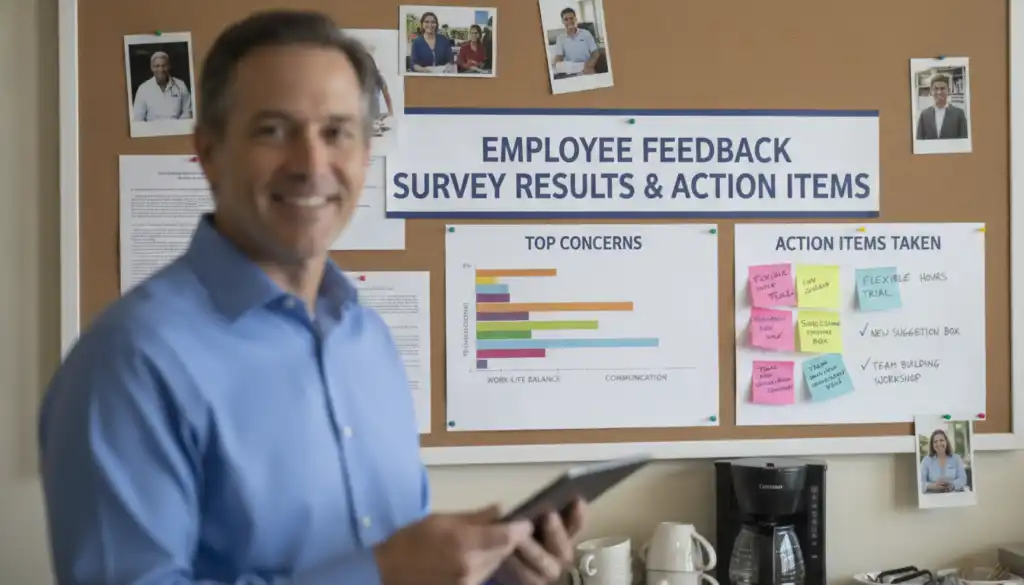
Staff need to see that their feedback changed something real, not just that management "cares." Post the before-and-after numbers on the break room board or share them in a shift huddle. SHRM’s research on engagement consistently shows recognition and visible follow-through do more for retention than one-time bonuses.
Common Mistakes When Trying to Improve Employee Satisfaction at a Café
The most common misstep is treating a survey as a one-and-done event instead of a cycle. Close behind that is management reading results privately and never sharing them back with the team, which kills trust for the next round. Many owners also chase perks, like free coffee or a pizza party, while ignoring the scheduling and pay issues actually driving people out the door.
Another frequent error is asking only broad, vague questions. "Are you happy here?" gets a shrug. Specific questions about shift fairness, tip pooling, and manager responsiveness get usable answers. And some operators wait until exit interviews to learn what went wrong, long after the employee has already decided to leave.

When to Call a Pro
A single independent café with five or six staff can often run this process in-house with a free survey tool and a committed owner. Once you’re managing multiple locations, inconsistent shift leads, or a turnover rate that keeps climbing despite your best efforts, the honest limit of DIY shows up fast: you need someone reading the data who isn’t also the person staff are nervous about upsetting.
That’s the gap a mom and pop firm like ours fills. Randy Starr spent 25+ years in hospitality leadership as a GM and Regional Manager before writing Employee Engagement: What the Hospitality Industry is Missing, and 5 Starr Engagement runs confidential surveys at 30 to 60 percent lower rates than big consulting firms, with root-cause data and an actionable plan instead of a generic report. If your team runs multiple cafés or sits inside a larger restaurant group, our restaurant employee surveys and employee engagement surveys are built exactly for that scale.
As of 2026, frontline burnout in food service remains stubbornly high, and the National Restaurant Association continues to flag staffing stability as the industry’s top operational challenge. There’s no single fix, and we won’t pretend otherwise. But a consistent measure-and-respond cycle is the single most reliable way we’ve seen to move employee satisfaction in the right direction.
Next Steps
- Choose a confidential survey method and send your first round this month.
- Benchmark your results against BLS food-service data.
- Fix scheduling pain points as a quick early win.
- Build a one-page action plan with named owners and deadlines.
- Re-survey in 60 to 90 days and share results with your team.
If you’d rather not build this process alone, book a free consultation with 5 Starr Engagement at 352-304-0655 and we’ll help you design a survey built for your café, not a generic corporate template.