


Beyond the Heatmap: How to Translate Culture Amp Survey Questions into Leadership Action
Optimizing your use of Culture Amp survey questions allows human resources teams to move past flat data points and implement behavioral leadership changes that increase overall retention. By aligning these science-backed questions with targeted internal development initiatives, organizations can accurately isolate systemic turnover drivers and build highly collaborative workplace cultures.
Employee feedback is no longer an optional corporate exercise. In the modern global economy, a highly motivated workforce serves as a core competitive differentiator. However, many enterprise companies struggle to collect actionable data from their corporate feedback cycles.
As of 2026, the modern workforce demands organizational clarity and clear career pathways. If your leadership team fails to translate raw percentages into immediate operational improvements, employees will quickly develop survey cynicism. This guide provides a detailed, step-by-step roadmap to maximizing your people analytics framework.
📌 Key Takeaways
Science-Backed Structure: Standardized organizational diagnostics reduce cognitive evaluation bias during employee feedback windows.
The 80/20 Balance: Combine 80% baseline industry benchmarks with 20% custom operational questions to maximize data utility.
Isolate Top Retention Drivers: Focus corporate resources exclusively on fixing low scores that directly correlate to employee exit intent.
Act Within 14 Days: Share transparent data summaries with staff rapidly to maintain deep organizational trust.
Eradicate Structural Bias: Avoid double-barreled questions and inconsistent rating models to keep your datasets reliable.
Table of Contents
Why Culture Amp Survey Questions are the Gold Standard
The 5 Core Pillars of Employee Engagement
Essential Survey Question Categories to Track
Developing Your Custom Survey Strategy
The Science of Survey Design: Avoiding Bias
Analyzing Data: From Heatmaps to Action Plans
Frequently Asked Questions (FAQ)
Quick Answer: Standardized survey questions leverage organizational psychology to remove phrasing bias, lower employee cognitive load, and provide global benchmarking data. This structure identifies precise engagement drivers so leadership teams can deploy target resources efficiently.
Why do the world’s leading brands rely heavily on structured engagement metrics? Unlike homegrown questionnaires that often suffer from internal team design bias, professional diagnostics are constructed on a baseline of workplace behavior research.
Science-Backed Structure
Every question is meticulously engineered to minimize cognitive load while maximizing emotional honesty. These diagnostic frameworks eliminate ambiguous wording that could skew sentiment metrics. This ensures your final datasets are clean, reliable, and ready for senior executive evaluation.
Global Benchmarking Capabilities
One of the greatest strengths of utilizing structured questions is the ability to compare your internal performance numbers against global industry standards.
Contextual benchmarking prevents your leadership team from acting on false signals. For example, it helps you identify if a dip in department morale is an isolated internal issue or part of a wider macroeconomic trend.
AI-Driven Actionable People Analytics
Modern employee feedback platforms utilize machine learning to map out specific engagement drivers. The system does not simply inform you that a specific department is unhappy. Instead, it highlights the exact underlying causes, such as lack of internal mobility or insufficient manager support, that are fueling the drop in morale.
📊 Data Point: Research published by the Society for Human Resource Management (SHRM) indicates that organizations using standardized, science-backed cultural diagnostics experience a 21% increase in overall corporate profitability due to targeted, data-driven management interventions.

Quick Answer: The engagement index measures five distinct psychological states: pride, recommendation intent, present commitment, future commitment, and baseline motivation. Averaging these scores calculates your property or company’s official Engagement Index Score.
True engagement goes significantly deeper than basic workplace happiness. A satisfied employee might be perfectly content to execute the bare minimum required to maintain their role.
Conversely, a fully engaged team member is emotionally and intellectually committed to your organization’s broader vision. To track this distinction, your people analytics framework must consistently measure five core areas:
Pride: Do your staff members feel proud to share where they work when speaking with external peers?
Recommendation Intent: Would your employees actively refer high-performing industry colleagues to open roles within your company?
Present Commitment: Are your team members genuinely motivated to deliver high-quality discretionary effort during their daily shifts?
Future Commitment: Can your top talent clearly visualize a viable, rewarding career path inside your organization over the next 24 months?
Motivation: Does your company’s overarching mission inspire employees to overcome complex project challenges?
Calculating the Engagement Index Score
By calculating the positive response rates across these five foundational pillars, you establish your company’s baseline engagement score.
| Engagement Pillar | High-Score Indicator | Recommended Action if Low |
| Pride & Recommendation | Active Brand Advocacy | Launch Internal Recognition Programs |
| Present & Future Commitment | Long-Term Talent Retention | Deploy Clear Career Progression Maps |
| Intrinsic Motivation | Sustained Discretionary Effort | Refine and Communicate Core Mission |
💡 Expert Insight: “A single dropping score in future commitment is the most reliable leading indicator of an impending talent exit wave. Leaders must monitor the relationship between present effort and future intent closely.”
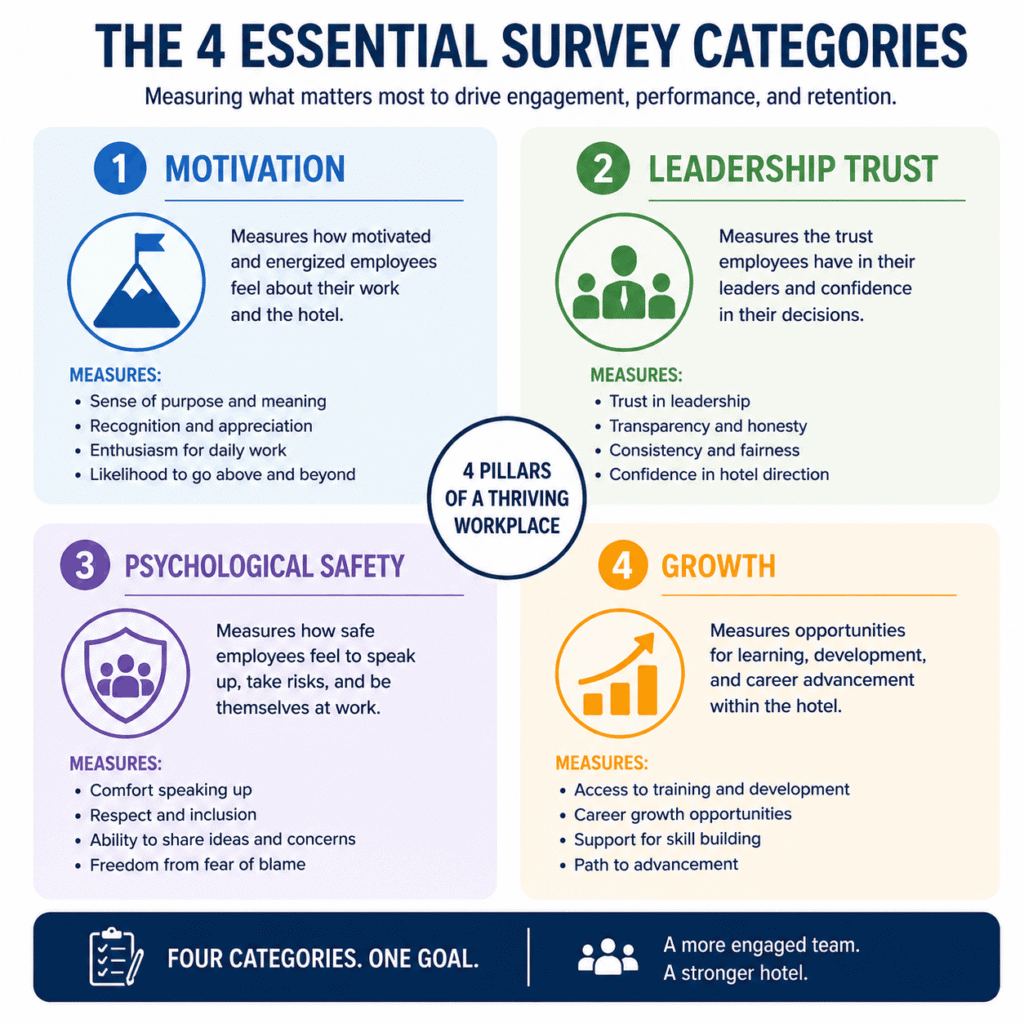
Quick Answer: A comprehensive employee survey must actively evaluate motivation, management trust, psychological safety, and professional development. Tracking these categories pinpoint exactly where organizational friction is occurring.
To build an adaptable workplace, your survey questions must target the specific touchpoints where employees experience organizational friction. Focus on these four core categories.
1. Employee Engagement and Motivation
These specific prompts serve as the primary thermometer of your workplace culture. They measure the raw emotional connection an employee maintains with their daily responsibilities.
“I feel inspired to go above and beyond my standard job description to help our team succeed.”
“I am genuinely proud to tell external professionals where I work.”
“I would confidently recommend this organization as an excellent place to work.”
2. Leadership and Management Trust
Managerial quality remains a primary driver of retention across global enterprise environments. If your staff loses confidence in senior leadership, they will seek roles elsewhere.
“My direct supervisor provides clear performance expectations and constructive feedback loops.”
“I trust the strategic decisions made by our executive leadership team.”
“Senior leadership communicates organizational goals and challenges transparently.”
3. Psychological Safety and Inclusion
A workplace culture rooted in fear or silencing mechanisms will inevitably experience stagnation and high turnover. Employees must feel safe to innovate.
“I feel comfortable sharing constructive dissenting opinions or operational concerns at work.”
“Diverse perspectives are actively sought out and valued during major decision-making processes.”
“I feel completely confident being my authentic self within this corporate environment.”
4. Career Development and Growth
When high-performing employees feel they have hit an artificial professional ceiling, they will look for opportunities outside your organization.
“I have access to excellent opportunities to learn new technical skills and expand my capabilities.”
“My direct manager actively advocates for my long-term career growth and internal mobility.”
“I maintain a clear, actionable understanding of what is required to advance my title here.”
⚠️ Common Mistake: Avoid phrasing questions abstractly. For instance, asking “Do you like your job?” generates highly subjective data. Instead, ask “Does your job allow you to utilize your greatest professional strengths?” to get actionable insights.
Quick Answer: The 80/20 survey strategy combines 80% standardized questions for industry benchmarking with 20% custom questions tailored to unique company initiatives. This balance maintains data integrity while addressing immediate corporate changes.
While utilizing verified baseline questions is vital for accurate industry benchmarking, every organization maintains its own unique set of cultural challenges. To address this reality, we advise companies to follow the 80/20 survey rule.
Implementing the 80/20 Survey Rule
Dedicate 80% of your questionnaire to the standardized library. This preserves your ability to track year-over-year internal trends and evaluate your performance against external industry competitors.
Dedicate the remaining 20% of your questionnaire to custom prompts that target current internal developments. For example, you can query employees on how a newly introduced hybrid work policy is impacting their cross-departmental collaboration.
At 5 Stars Engagement, we partner with executives to bridge the gap between these raw metrics and active floor-level leadership development. By reviewing curated 5 Star Engagement strategies, executive teams can successfully transition from passive data collection to impactful leadership coaching models.
Quick Answer: Unbiased survey design requires removing double-barreled prompts, utilizing a consistent 5-point Likert scale, and guaranteeing absolute respondent anonymity. These measures ensure employees provide authentic, unfiltered answers.
The precision of your data is entirely dependent on the structural integrity of your questions. If a prompt is poorly worded, it will lead to skewed results and wasted resources.
Eliminating Double-Barreled Prompts
Never combine two distinct topics into a single question. For example, asking “Are you satisfied with your compensation package and your direct supervisor?” creates massive analytical confusion. An employee may love their manager but feel vastly underpaid. Split these distinct ideas into independent, clear prompts.
Standardizing the Metric Scale
Utilize a consistent 1-to-5 Likert scale ranging from Strongly Disagree to Strongly Agree. Consistency across questions reduces employee survey fatigue and keeps the data clean.
According to a workplace communication study published by Harvard Business Review, changing rating scales mid-survey causes cognitive friction that leads to high drop-off rates and inaccurate data.
Securing Absolute Anonymity
If your workforce believes their managers can link individual negative answers back to their corporate profiles, they will provide safe, falsified data. Ensure your survey parameters require aggregated data blocks to protect individual privacy.
✅ Quick Tip: Always include a text-based open-ended question at the end of each section. This allows your team to capture the qualitative context behind your quantitative metrics.
Quick Answer: Heatmaps organize survey results by color-coding departments to highlight operational risks and successes. To build an action plan, leaders must focus on high-impact engagement drivers rather than isolated complaints.
Once your feedback window officially closes, your core operational work begins. Avoid getting overwhelmed by massive datasets by utilizing structured color-coded heatmaps.
Isolating Departmental Variations
Heatmaps allow HR leaders to instantly spot variance across your organization. A specific department glowing “Red” indicates an active turnover risk requiring swift management support. Conversely, a department consistently showing “Green” offers valuable internal insights that can be modeled across other teams.
Prioritizing High-Impact Drivers
Not all low scores carry the same operational weight. If your team scores poorly on a metric that your analytics tool identifies as a low driver of retention, it should not be your top priority.
Focus your resources on areas where low scores intersect with high impact drivers, such as manager trust or psychological safety. To turn these insights into reality, explore our comprehensive [internal guide to leadership development] to align your management teams with your new cultural goals.
How often should we deploy Culture Amp survey questions to our team?
We recommend executing one comprehensive engagement survey annually, balanced by two to three targeted quarterly pulse surveys. This cadence allows leadership to monitor cultural shifts in real-time without causing widespread employee survey fatigue.
What is a double-barreled question in workplace surveys?
A double-barreled question incorrectly combines two separate operational topics into a single question, such as asking about pay and management quality simultaneously. This structural flaw confuses respondents and ruins the statistical validity of your final dataset.
How do you explain low survey scores to senior executive leadership?
Present low scores transparently by framing them alongside a clear, data-driven action plan. Focus heavily on identifying the specific engagement drivers that correlate with retention, and outline the precise leadership coaching steps you will take to resolve the issues.
Can an engagement survey be effective if it is not anonymous?
No, non-anonymous surveys fail to generate accurate data regarding sensitive issues like leadership trust or workplace psychological safety. Employees will instinctively provide safe, positive answers to avoid potential career friction or management retaliation.
What is an Engagement Index Score and how is it calculated?
An Engagement Index Score is a metric that calculates the average positive sentiment across five core pillars: pride, recommendation intent, present commitment, future commitment, and intrinsic motivation. It serves as the primary health check of your corporate culture.
How quickly should management share survey results with the broader company?
Management should share a transparent, high-level summary of both positive and negative survey results within 14 days of the survey window closing. Fast communication builds deep organizational trust and proves to employees that their feedback is valued.
Conclusion: Building a Culture of Continuous Listening
Optimizing your use of Culture Amp survey questions is the first step toward building a world-class, high-retention workplace culture. By asking science-backed questions, maintaining rigorous data anonymity, and focusing on high-impact engagement drivers, you transform static HR metrics into a dynamic engine for leadership transformation.
Data without a swift operational response breeds internal employee cynicism. Leaders must move rapidly from evaluation to execution to maintain trust.
Next Steps for People Operations Leaders:
Audit your upcoming survey draft and eliminate any biased or double-barreled questions.
Structure your questionnaire to follow the 80/20 rule, preserving baseline benchmarking fields.
Establish a clear internal communication plan to share high-level results within 14 days of closing.
Partner with experienced advisors to design targeted post-survey leadership coaching tracks.
Ready to transform your cultural data into a robust roadmap for organizational growth? Connect with the enterprise team at 5 Star Engagement solutions today to launch your customized workplace transformation strategy!