


Frontline Staff Retention: The Ultimate Guide to Stop the Mid-Summer Churn
Achieving sustainable frontline staff retention requires replacing reactive, amateur fixes with structured 90-day onboarding architectures and professional management training frameworks. Organizations must diagnose the precise root causes of early-stage burnout, optimize workplace culture metrics, and deploy clear milestone mapping to secure operational stability. Implementing these professional systems stabilizes service teams, prevents costly replacement cycles, and protects long-term corporate profitability.
The summer heat brings more than just rising temperatures. For service, hospitality, entertainment, and retail industries, it triggers a devastating wave of employee turnover known as the mid-summer churn. If you manage a frontline workforce, you are likely intimately familiar with this exhausting cycle. Your HR team hires a wave of enthusiastic team members in May, only to watch them vanish before Labor Day.
The first 90 days of an employee’s lifecycle represent a highly fragile operational window. If a new hire does not feel engaged, supported, and structurally integrated within this timeframe, they will walk out the door. Many organizations attempt to patch this leaking bucket with quick, amateur DIY fixes. However, temporary solutions fail to address the systemic operational and cultural failures that drive people away. To build a resilient workforce, businesses must move beyond superficial perks and embrace professional, data-driven frameworks.
📌 Key Takeaways
Target the First 90 Days: Focus engagement efforts heavily on the initial three months to disrupt peak historical turnover windows.
Audit Attrition Expenses: Quantify direct and indirect recruitment losses to understand the true bottom-line impact of churn.
Ditch Superficial Perks: Replace transactional rewards like pizza parties with meaningful leadership accountability and equitable scheduling.
Standardize Onboarding: Deploy a multi-phase, 90-day onboarding roadmap that prioritizes psychological safety and autonomous integration.
Leverage External Insights: Use validated third-party metrics and professional consulting to identify hidden structural bottlenecks.
Table of Contents
Understand the Anatomy of the 90-Day Mid-Summer Churn
Calculate the Real Financial Cost of Frontline Attrition
Avoid the Dangerous Illusion of DIY Engagement Programs
Deploy Professional Frontline Staff Retention Strategies
Realize Why Professional Systemic Upgrades Outperform In-House Fixes
1. Understand the Anatomy of the 90-Day Mid-Summer Churn
⚡ Quick Answer
The 90-day frontline churn is caused by immediate operational reality shock, unmet workplace culture expectations, and social isolation. When summer customer volumes peak, inadequate onboarding and poor leadership communication cause rapid employee burnout.
To fundamentally improve your frontline staff retention, you must first dissect why the first 90 days of employment are uniquely volatile. This is particularly true during the high-stress summer months. When new hires enter your ecosystem in June or July, they step directly into the deep end of operations. Business volume is at its peak, existing staff members battle fatigue, and onboarding processes are frequently skipped entirely. This creates a perfect storm for rapid attrition.
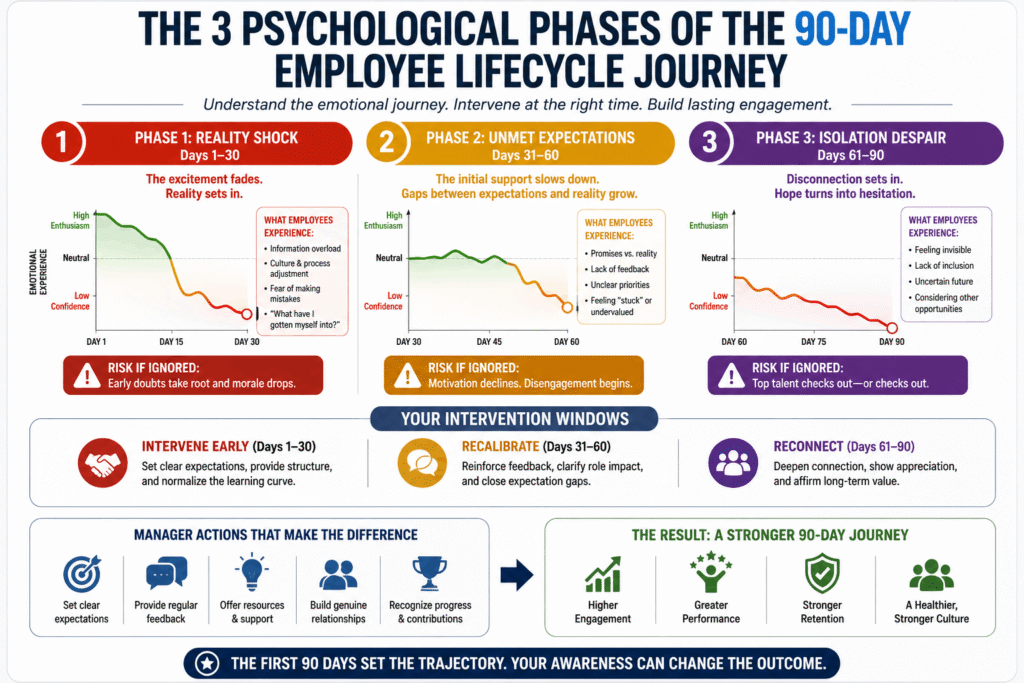
Days 1 to 30: The Reality Shock and Burnout Trap
During the first month, the employee transitions from the idealized version of the job to the operational reality. Frontline workers bear the immediate brunt of customer frustration, long shifts, and erratic schedules. If they are thrown onto the floor without adequate training or a dedicated peer mentor, early-stage burnout occurs within weeks.
📊 Data Point
Operational data indicates that workplace stress significantly escalates early turnover risks. According to recent federal workplace health insights from the CDC Workplace Health Resource Center, unmanaged occupational fatigue directly accelerates employee resignation timelines by up to 40% within high-volume environments.
Days 31 to 60: The Unmet Expectations Gap
By the second month, the employee has mastered basic tasks but begins evaluating the workplace culture. They look around and ask: Is this environment sustainable? Do my managers respect me? Mismatched expectations drive early turnover. When the reality reflects high stress and poor communication, the cognitive dissonance drives them to start browsing job boards again.
Days 61 to 90: The Isolation Despair
If a new hire survives the 60-day mark, their final hurdle is social integration. Human beings are inherently social creatures. If a frontline worker feels isolated or treated like a temporary cog in a machine, their loyalty drops to zero. Without a clear sense of belonging and recognition, they will quit the moment a slightly higher-paying alternative appears.
2. Calculate the Real Financial Cost of Frontline Attrition
⚡ Quick Answer
Frontline turnover costs between $5,800 and $14,500+ per individual worker. These costs stem from recruitment sourcing, management labor, extensive onboarding training, lost operational productivity, and premium overtime wages.
Every time a frontline worker walks out the door within their first 90 days, your business suffers a direct financial blow. Far too many executives mistakenly categorize frontline turnover as “just the cost of doing business.” This is a dangerous, expensive misconception that erodes corporate profitability.
To build a sustainable frontline staff retention playbook, you must first measure the specific financial liabilities of attrition. The structural layout below breaks down these expenses.
| Expense Category | Direct Operational Components | Estimated Cost Per Employee |
| Recruitment & Sourcing | Job board postings, applicant tracking software, background checks. | $500 – $1,500 |
| Management Labor | Time spent vetting resumes, conducting interviews, and processing HR paperwork. | $800 – $2,000 |
| Onboarding & Training | Paid training hours, instructional materials, reduced team efficiency during shadowing. | $1,000 – $3,000 |
| Lost Productivity | Slower service speeds, customer friction, increased errors from understaffing. | $2,000 – $4,500 |
| Overtime Premiums | Paying remaining staff time-and-a-half to cover vacant shifts. | $1,500 – $3,500 |
| Total Financial Drain | Cumulative economic loss per single lost frontline worker. | $5,800 – $14,500+ |
When you multiply these numbers across dozens of employees lost during a single mid-summer churn cycle, the financial loss quickly balloons. This bleeding capital weakens your bottom line and damages your customer service consistency. Ultimately, poor retention directly threatens your brand reputation.
⚠️ Common Mistake
Treating frontline attrition as an unavoidable, fixed operational cost. Failing to calculate the compounding expense of overtime premiums and lost productivity blinds executives to the immense financial return of retention optimization.
3. Avoid the Dangerous Illusion of DIY Engagement Programs
⚡ Quick Answer
DIY engagement programs fail because they offer surface-level perks instead of addressing systemic operational issues. Temporary fixes like pizza parties do not solve unequal scheduling, low compensation, or poor management.
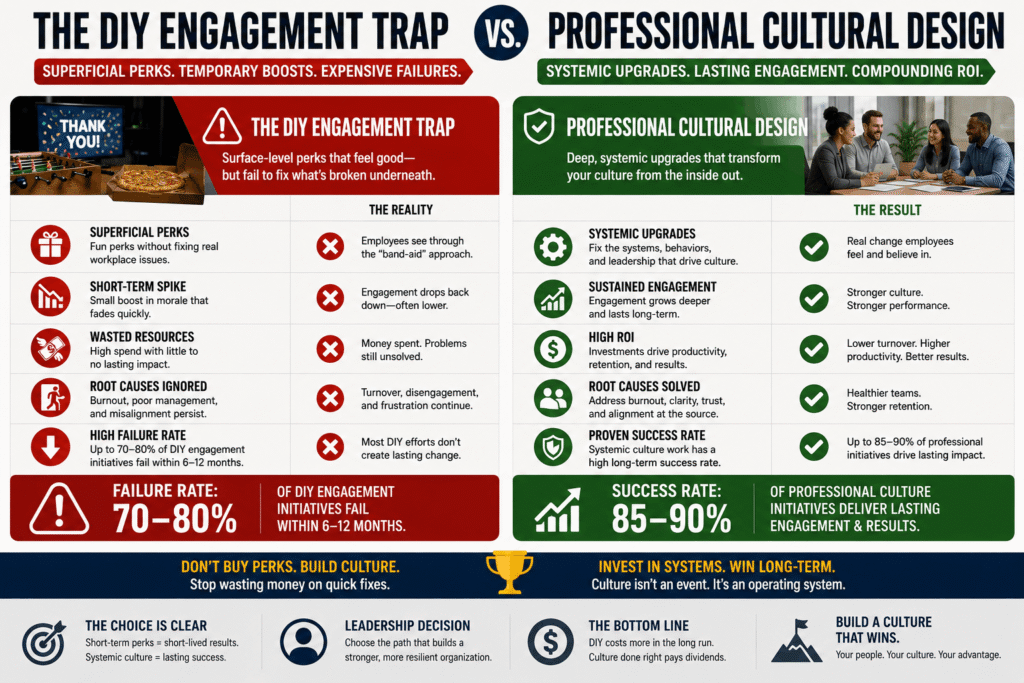
When frontline turnover begins to climb in July, well-meaning managers often scramble to take matters into their own hands. They look for fast, low-cost, amateur ways to lift morale and stabilize the ship. This gives rise to the “DIY Engagement Trap”, a series of superficial fixes that actually exacerbate the problem.
Why Pizza Parties and Gift Cards Fall Short
You cannot solve deep structural and operational deficiencies with a casual pizza party, a generic employee-of-the-month plaque, or sporadic gift cards. While these small gestures are pleasant, they do absolutely nothing to alleviate the root causes of the mid-summer churn.
[DIY Surface Fixes: Pizza Parties / Gift Cards]
                     │
                     ▼ (Fail to fix)
[Root Systemic Issues: Erratic Schedules / Poor Management / Low Pay]
Employees see through surface-level initiatives. They perceive them as cheap substitutes for real management accountability, equitable scheduling, competitive compensation, and psychological safety. When workers feel patronized by superficial perks, their desire to leave intensifies.
💡 Expert Insight
True workplace engagement is built on systemic equity and respect, not transactional rewards. Rigorous research published in the Harvard Business Review demonstrates that structural factors, such as predictable scheduling and authentic psychological safety, influence long-term employee retention far more than superficial corporate perks.
The Flaws of In-House, Non-Anonymous Surveys
Many internal HR departments attempt to build home-grown survey tools to gauge frontline satisfaction during peak seasons. However, without independent, professionally validated metrics, frontline employees rarely provide honest feedback out of a justified fear of management retaliation. The resulting data is skewed, overly optimistic, and ineffective for building a sustainable framework for frontline staff retention. To design a workplace culture that people refuse to leave, you must move away from amateur guesswork.
4. Deploy Professional Frontline Staff Retention Strategies
⚡ Quick Answer
Professional frontline retention strategies require launching a structured 90-day onboarding architecture, training supervisors under specialized leadership models, and establishing clear milestone-based career advancement paths.
True retention cannot be achieved through luck; it must be engineered through structured, professional frameworks. If you want to protect your workforce during peak summer pressures, you must deploy proven methodologies that address the holistic lifecycle of your frontline staff.
Structured, Dynamic Onboarding Architectures
Onboarding must never be treated as a passive, one-day event dedicated to filling out tax forms and reviewing compliance videos. A professional onboarding program spans the entire 90-day window, providing structured support at every step.
Phase 1 (Days 1–30): Psychological Safety & Clarity. Focus on thorough role training, clear performance expectations, and pairing the new hire with a dedicated peer buddy.
Phase 2 (Days 31–60): Skill Mastery & Recognition. Introduce targeted skill-building milestones and celebrate early operational successes to build confidence.
Phase 3 (Days 61–90): Autonomy & Long-Term Integration. Transition the employee into long-term career pathing, solicit anonymous feedback, and grant greater operational autonomy.
✅ Quick Tip
Pair every new hire with a certified peer mentor during their first 30 days. This baseline social connection accelerates role mastery and effectively mitigates early-stage operational isolation.
Implementing the 5-Star Leadership Model
Frontline workers rarely quit their companies; they quit their direct supervisors. In high-volume environments, mid-level supervisors are frequently promoted based on technical skill or tenure rather than actual leadership capabilities.
Providing your management team with professional leadership training ensures they know how to coach, motivate, and de-escalate tension rather than manage through fear or micromanagement. When leadership practices meet professional standards, employee engagement increases naturally. For deeper insights on transforming manager behaviors and upgrading your internal leadership metrics, explore our specialized training solutions at our 5-Star Engagement Culture Hub.
Advanced Milestone Mapping and Clear Career Paths
Frontline staff need to see an immediate, clear future within your organization. A professional retention strategy maps out clear advancement pathways within the first two weeks of employment. If a worker knows exactly what operational metrics they must achieve to earn a raise, a title shift, or leadership responsibilities, they are far less likely to quit for a minor pay increase down the street. Giving them a clear roadmap turns a temporary job into a meaningful career path.
5. Realize Why Professional Systemic Upgrades Outperform In-House Fixes
⚡ Quick Answer
Professional upgrades outperform in-house fixes by utilizing unbiased third-party audits, scientifically validated psychological engagement frameworks, and scalable operational playbooks that permanently lower recruitment costs.
Fixing a broken organizational culture requires specialized diagnostic tools, behavioral science insights, and deep industry benchmarking data. Just as you wouldn’t allow an untrained amateur to manage your corporate legal strategy or tax compliance, you shouldn’t rely on amateur, reactive DIY methods to manage your most valuable asset: your people.
The Benefits of Independent Cultural Consulting
Partnering with an external consulting firm yields clear benefits for your organization:
Unbiased Workplace Auditing: External experts uncover hidden cultural bottlenecks, leadership blind spots, and systemic frustrations that internal teams are often too close to see.
Scientific Engagement Metrics: Professional optimization groups leverage validated psychological frameworks, similar to those utilized in Gallup Workplace Research, to measure the exact underlying drivers of human motivation and workforce loyalty.
Sustainable Systemic Playbooks: Instead of temporary band-aids, professionals implement enduring operational protocols that preserve morale year after year, regardless of seasonal volume changes.
Investing in expert cultural design saves your business thousands of dollars in ongoing recruitment costs, boosts everyday operational productivity, and elevates your overall brand reputation. To discover how a tailored workforce assessment can protect your operations, explore the advisory resources available through our dedicated 5-Star Engagement Services Portal.
💡 Expert Insight
In my years auditing high-churn service environments, I have observed that organizations adopting third-party validated tracking mechanisms experience a radical stabilization in frontline longevity. As of 2026, relying purely on internal human resource evaluations introduces structural biases that consistently mask the true operational pain points of the hourly workforce.
Frequently Asked Questions
What are the main drivers of high frontline staff retention?
The primary drivers of successful workforce retention include structured onboarding paths, predictable scheduling, competitive compensation, and supportive direct management. Workers remain loyal when they experience psychological safety and clear, milestone-based opportunities for internal promotion.
How do you measure frontline employee turnover costs accurately?
To calculate turnover costs accurately, management must combine direct hiring fees, background checks, and HR onboarding labor with indirect costs. These indirect costs include premium overtime wages paid to cover open shifts and the lost productivity caused by customer service friction.
Why does employee turnover peak during the summer season?
Turnover peaks in the summer due to a combination of surging customer volumes, accelerated operational stress, and rushed training cycles. Frontline employees often experience immediate reality shock and rapid physical burnout when thrown onto the floor without proper structural support.
Can flexible scheduling improve seasonal employee retention metrics?
Yes, flexible and predictable scheduling directly improves retention metrics by reducing work-life conflict and occupational fatigue. Providing hourly staff with transparent, collaborative schedule management platforms fosters professional trust and lowers unexpected structural resignations.
What is the role of direct supervisors in frontline staff retention?
Direct supervisors are the most critical factor in managing frontline longevity. Managers trained in professional leadership methodologies coach and motivate teams effectively, whereas untrained supervisors who rely on micromanagement actively accelerate employee attrition.
Secure Your Frontline Future
Implementing successful frontline staff retention requires moving past the illusion of quick, home-grown fixes. To permanently eliminate the mid-summer churn, corporate leaders must build rigorous operational frameworks that value, train, and support hourly workers.
Your Immediate Next Steps:
Conduct a Comprehensive Attrition Audit: Quantify the total direct and indirect financial costs of your turnover from the past 12 months.
Redesign the Initial 30-Day Windows: Install a formal peer-buddy mentoring system for every incoming frontline hire.
Deploy Anonymous Feedback Channels: Replace vulnerable internal surveys with independently managed, secure feedback frameworks.
Train Mid-Level Supervisors: Enroll operational managers in specialized leadership courses that focus on active team de-escalation and positive coaching.
Do not let another high-volume season drain your corporate profits, exhaust your leadership teams, and damage customer satisfaction. Move beyond temporary survival mode and establish a corporate culture that inspires deep loyalty, operational excellence, and long-term commitment.