


Targeted Retention Strategies: Why Massive Survey Firms Miss the Root Cause of Your Turnover
Developing effective targeted retention strategies requires ditching rigid, automated corporate surveys in favor of agile, qualitative cultural diagnostics. When massive enterprise survey firms deploy generic questionnaires, they completely miss the localized operational friction driving top talent away. To permanently stop employee turnover, organizations must utilize professional, third-party interventions that provide authentic psychological safety and uncover the real root causes of team frustration.
High employee turnover is an incredibly costly operational challenge. When departures begin to spike, executive boards routinely write massive checks to legacy survey firms. They expect a complex data dashboard to instantly fix their talent drain.
Yet, months after deploying these cookie-cutter platforms, the needle barely moves. The core problem remains unaddressed. Corporate data tracking acts as a sterile screen, concealing the deep-seated cultural fractures driving your people out the door. To safeguard your workforce and protect your bottom line, you must embrace professional, agile intervention.
📌 Key Takeaways
Standardized surveys hide the truth: Generic questions strip away the unique local context of your talent loss.
Survey fatigue erodes trust: Constantly polling employees without making structural changes accelerates active exit plans.
Track the whole lifecycle: Effective retention requires data from onboarding to exit interviews.
Psychological safety is mandatory: Internal DIY surveys fail because employees fear management retaliation.
Agile consulting beats software bloat: Hands-on professional discovery uncovers root causes that dashboards simply cannot see.
Table of Contents
The Fatal Flaw of Enterprise Survey Platforms
Why Standardized Metrics Distort Corporate Discovery
Tracking the Complete Employee Lifecycle
Boutique Agility vs. Enterprise Bloat
The High Danger of DIY Retention Schemes
A Professional Blueprint for Sustainable Cultural Health
Frequently Asked Questions
1. The Fatal Flaw of Enterprise Survey Platforms
⚡ Quick Answer
Enterprise survey platforms fail because they use pre-packaged, rigid questions that ignore local workplace nuances. They aggregate highly disparate feedback into a centralized index, leaving leadership blind to the specific departmental issues causing turnover.
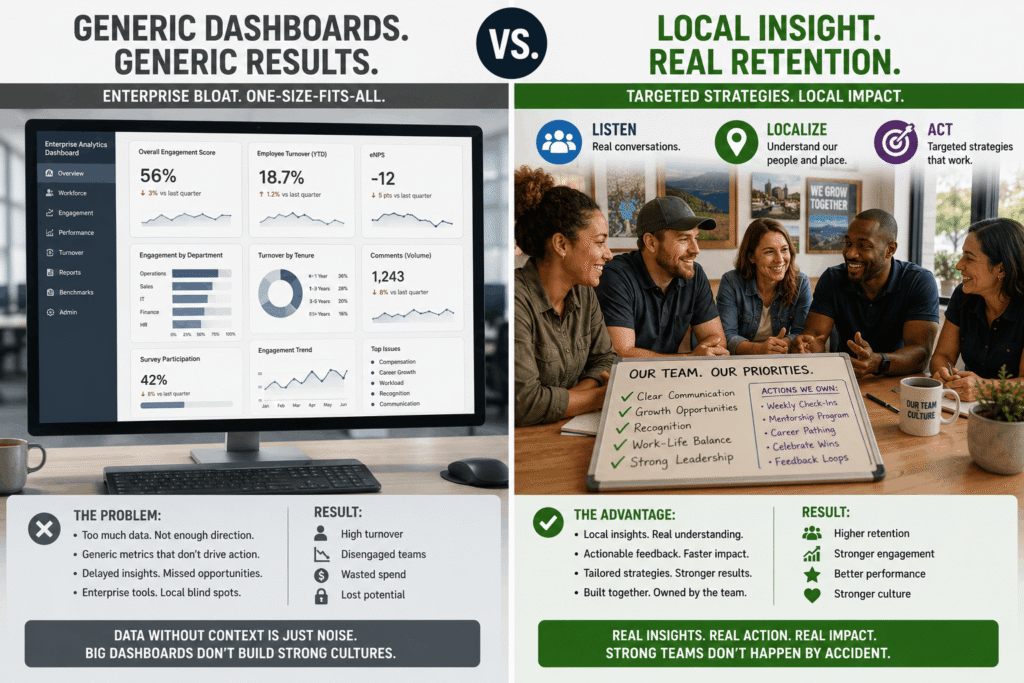
Massive survey vendors specialize in raw scale, not organizational nuance. They approach your complex workforce with a rigid set of generic questions. These platforms are designed to fit thousands of entirely different businesses worldwide.
By treating your unique corporate environment like a standardized assembly line, they strip away context. When an organization relies exclusively on these giant platforms, executives drown in surface-level metrics.
The Illusion of Centralized Data
A standardized report might tell you that 62% of mid-level managers feel unaligned with corporate goals. However, the automated data cannot tell you the real story. Is it a toxic department head? Are cross-departmental communication workflows broken? Is it an outdated hybrid work policy?
⚠️ Common Mistake
Assuming that a high survey completion rate equals high employee engagement. Often, employees rush through mandatory enterprise surveys just to clear their inbox, providing highly inaccurate data to leadership.
Flattening Critical Subcultures
Enterprise software platforms completely smooth over the distinct subcultures within your business. A corporate headquarters in New York operates under vastly different social dynamics than a remote engineering squad.
Aggregating this feedback into a centralized corporate index flattens crucial distinctions. This leaves leadership blind to the operational realities required to build successful targeted retention strategies.
2. Why Standardized Metrics Distort Corporate Discovery
⚡ Quick Answer
Standardized metrics shift focus from active human listening to passive score manipulation. Over-surveying without taking action creates severe survey fatigue, leading to distorted response bias and broken corporate policies.
True organizational health cannot be calculated by a rigid algorithm. Automated dashboards shift focus away from human listening and onto passive metric chasing. Local managers spend their energy manipulating survey participation scores rather than making structural improvements.
Furthermore, over-surveying your workforce without making visible changes creates intense survey fatigue.
The Danger of Survey Fatigue
When employees invest time into repetitive questionnaires and witness zero operational adjustments, trust erodes. They quickly realize their candid feedback is just window dressing for an executive slide deck. This specific realization accelerates their active exit plans.
📊 Data Point
Research on workplace psychology published by the Society for Human Resource Management (SHRM) reveals that uncustomized corporate surveys frequently suffer from extreme response bias, as fearful or disengaged workers provide falsely positive answers.
Consequently, expensive enterprise software serves up highly distorted data. This forces your leadership team to build corporate policies on a fragile foundation.
3. Tracking the Complete Employee Lifecycle
⚡ Quick Answer
To build lasting loyalty, organizations must gather qualitative insights at every touchpoint of the employee lifecycle. This includes optimized onboarding diagnostics, real-time agile pulse interventions, and confidential third-party exit interviews.
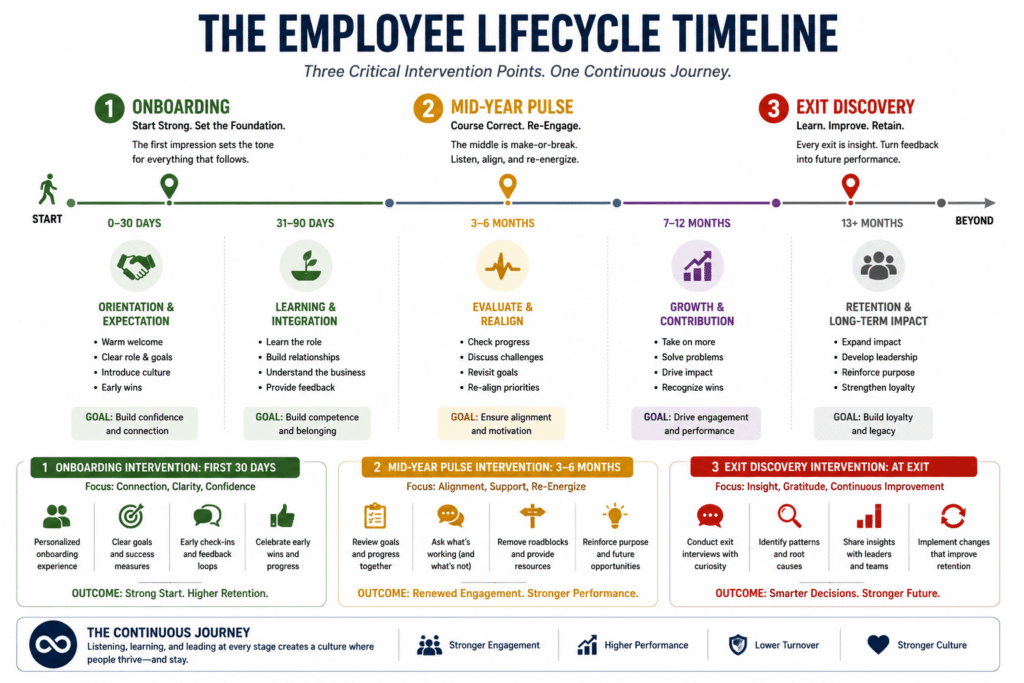
To build employee loyalty that lasts, an organization must look far beyond the annual engagement pulse check. True cultural transformation requires analyzing the entire employee lifecycle. You must gather deep, qualitative insights at every critical touchpoint.
Three Essential Lifecycle Touchpoints
Optimized Onboarding Diagnostics: Capture early feedback within the first 30 to 90 days. Determine if the reality of the workplace matches the expectations set during recruitment.
Agile Pulse Interventions: Deploy brief, customized check-ins around real-time operational shifts. Do not wait for rigid corporate calendars.
Confidential Exit Discovery: Utilize objective third-party interviewers. Extract the unvarnished truth about why top performers are handing in resignations.
✅ Quick Tip
Never let an employee’s direct manager conduct their exit interview. Always use a neutral third party to ensure the feedback is honest and actionable.
By assessing these distinct phases with professional precision, you can pinpoint exactly where friction occurs. This structured data allows you to deploy targeted retention strategies that address local pain points early.
4. Boutique Agility vs. Enterprise Bloat
⚡ Quick Answer
Agile culture consulting embeds professionals directly into your business architecture to execute empathetic discovery. Unlike software vendors that provide generic dashboards, boutique firms adapt methodologies in real time to uncover hidden workplace truths.
This is precisely where agile, specialized culture consulting shifts the organizational paradigm. Boutique firms do not simply sell you a software license and leave your HR department to interpret the wreckage.
Instead, they act as hands-on partners. They embed themselves directly into the unique architecture of your business to execute empathetic cultural discovery.
Real-Time Diagnostic Adaptation
Boutique agility means adapting the diagnostic process in real time. If an expert team senses unspoken friction within a department, they pivot immediately. They leverage qualitative interviews, focused leadership listening sessions, and tailored pulsing mechanisms.
Evaluation Matrix: Software Vendors vs. Agile Consulting
| Diagnostic Attribute | Massive Enterprise Software | Professional Agile Consulting |
| Primary Methodology | Automated, rigid questionnaires | Highly customized, dynamic discovery |
| Data Integrity | High risk of distorted response bias | High accuracy via psychological safety |
| Operational Impact | Surface-level metrics only | Direct blueprints for targeted retention strategies |
| Execution Style | Self-service software dashboard | Dedicated, high-touch professional guidance |
By identifying exact psychological bottlenecks, agile experts help you craft highly focused employee engagement frameworks.
5. The High Danger of DIY Retention Schemes
⚡ Quick Answer
In-house DIY retention programs fail because internal HR teams lack the neutrality required to ensure psychological safety. Employees will withhold honest feedback if they fear retaliation, resulting in misleading data and continued high turnover.
When leaders realize enterprise platforms are failing, they often try to manage cultural diagnostics in-house. Attempting a DIY approach to patch over shifting organizational cultures is a high-risk gamble.
The Lack of Psychological Safety
First and foremost, an internal DIY culture initiative lacks absolute psychological safety. Employees are highly perceptive. They know exactly who controls the internal network links and survey spreadsheets.
If a worker fears their critical feedback could threaten their standing, they will completely withhold the truth.
💡 Expert Insight
According to authoritative organizational cost data from the Harvard Business Review, replacing a highly skilled professional costs an organization anywhere from one-half to two times that individual’s annual salary. Relying on amateur DIY approaches is an expensive operational failure.
The Burden of Internal Bias
Furthermore, internal HR teams are naturally burdened by corporate politics and systemic biases. They are often too close to the executive leadership team to objectively diagnose failures.
An internal department simply cannot provide the neutral perspective required to call out toxic managerial behaviors. Without professional distance, DIY initiatives generate highly misleading pictures of employee satisfaction.
6. A Professional Blueprint for Sustainable Cultural Health
⚡ Quick Answer
Sustainable cultural health requires partnering with seasoned external architects who use specialized data methodologies. Professional consultants bridge internal communication gaps and align workplace principles with daily operational realities to eliminate turnover.
Resolving systemic cultural friction requires partnering with seasoned external professionals. These experts treat culture as an ongoing, living strategy rather than an administrative checklist.
Professional culture architects bring specialized analytical methodologies and an unyielding commitment to data neutrality.
Building a Competitive Advantage
A dedicated professional partner helps you look past surface-level symptoms. They implement holistic, sustainable operational transformations. They ensure your underlying workplace principles align closely with your daily operational realities.
When you transition away from rigid software platforms, you open the door to true workplace stabilization. Experienced professionals collaborate with leadership to implement high-impact cultural blueprints. This structural approach heals rifts, bridges gaps, and builds an environment where elite talent stays.
Frequently Asked Questions
What are targeted retention strategies?
Targeted retention strategies are customized, localized action plans designed to keep top employees from leaving a company. Unlike broad corporate initiatives, these strategies address the specific operational and psychological pain points of individual departments or teams.
Why do massive corporate employee surveys fail?
Massive corporate surveys fail because they rely on rigid, standardized questions that ignore unique workplace subcultures. They create survey fatigue and rarely result in tangible operational changes, which ultimately erodes employee trust.
How can a company guarantee psychological safety in surveys?
A company guarantees psychological safety by partnering with an independent, third-party consulting firm. When employees know their candid feedback is collected confidentially by outsiders, they are far more likely to report toxic behaviors without fear of management retaliation.
What is the true financial cost of employee turnover?
The true cost of replacing a highly skilled employee ranges from 50% to 200% of their annual salary. This includes direct recruitment costs, lost operational productivity, and the time management spends interviewing and onboarding replacements.
When should a company conduct an employee pulse check?
Companies should conduct brief, agile pulse interventions immediately following major operational shifts, leadership changes, or critical project completions. This real-time approach captures accurate cultural data far better than strict, annual calendar-based surveys.
Stop the Talent Drain Today
Executing effective targeted retention strategies means leaving behind the illusion of automated, generic dashboards. To genuinely stabilize your workforce, you must prioritize agile, human-centric discovery that provides complete psychological safety to your staff.
Your Immediate Next Steps:
Audit your current survey platforms: Identify where generic metrics are hiding specific departmental friction.
Halt in-house DIY data collection: Protect data integrity by utilizing external, neutral third-party facilitators.
Map the entire lifecycle: Implement customized feedback loops at the onboarding, mid-year, and exit stages.
Partner with culture architects: Engage an agile consulting firm to design a highly focused, localized retention blueprint.
Stop letting enterprise bloat and amateur DIY schemes drain your top talent. Take action today to build a resilient, communicative, and fiercely loyal corporate culture.