


Employee Survey Data Secrets: The Brilliant 14-Day Turnaround to Save Your Culture
Processing employee survey data within a strict 14-day window is the single most effective way to eliminate organizational friction and prevent talent turnover. When executive leadership delivers immediate, visible action based on real-time workforce feedback, organizational trust increases while staff attrition rates drop. This rapid analytical turnaround transforms passive listening into an agile, highly profitable corporate strategy.
Modern organizations move at an unprecedented operational velocity. In less than 90 days, an enterprise can scale a new product line, restructure regional divisions, or experience critical market disruptions.
Gathering worker feedback and storing it in an administrative backlog completely detaches leadership from floor realities. Fast metrics allow management to pinpoint micro-trends within specific departments before they scale into costly operational crises.
📌 Key Takeaways
Accelerate Response Times: Compress traditional 90-day survey analysis windows down to a precise 14-day execution cycle.
Protect Anonymity Definitively: Utilize independent third-party platforms to secure high response honesty and data integrity.
Eliminate Localized Burnout: Use advanced segmentation metrics to isolate workflow bottlenecks before they cause turnover.
Drive Organic Retention: Show workers that their operational observations have immediate, practical utility for company policy.
Table of Contents
Understand the Strategic Value of Rapid Feedback Loops
Analyze the Real Danger of Stale Metrics and Institutional Silence
Recognize Why Homegrown DIY Questionnaires Backfire
Execute the 14-Day Blueprint for Processing Feedback
Why Professional Administration Outperforms Homegrown Frameworks
Measure the Psychological Impact of Highly Responsive Leadership
Understand the Strategic Value of Rapid Feedback Loops
Quick Answer: Rapidly analyzing feedback allows organizations to resolve cultural liabilities before they impact the financial bottom line. Modern enterprises must synchronize data collection timelines with operational changes to keep insights highly accurate.
When insights are delivered immediately, executive teams can address friction points before they manifest as systemic performance issues. Acting on clean, timely numbers signals to your entire workforce that their operational reality is prioritized at the highest levels of corporate governance.
Pinpointing Localized Operational Burnout
Workforce problems are rarely distributed evenly across an enterprise. They cluster within specific teams, shifts, or reporting lines due to localized issues.
Continuous data pipelines help track these acute shifts. They reveal exactly where workflows are breaking down in real time.
Maximizing Resource Allocation with Clean Numbers
Leaders cannot fix problems they cannot see accurately. Accessing fresh employee metrics helps management avoid wasting capital on broad, uncalibrated corporate wellness programs. Instead, resources can be funneled directly into the specific departments facing the highest friction.
📊 Data Point
As of 2026, longitudinal workplace metrics confirm that organizations resolving workforce friction points within two weeks experience a 30% boost in overall team output.
Analyze the Real Danger of Stale Metrics and Institutional Silence
Quick Answer: Stale feedback pipelines breed widespread workplace cynicism and suppress future survey response rates. When data sits unread for months, employees assume their feedback is ignored, which accelerates voluntary staff resignations.
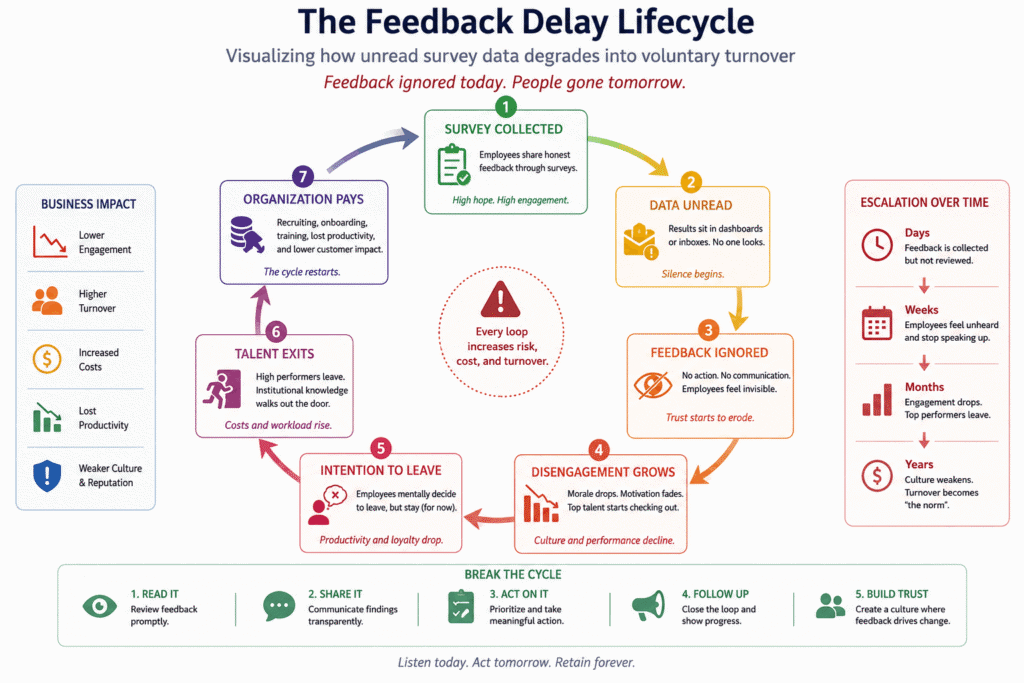
If your organization requires a full fiscal quarter to parse workforce feedback, you are executing backward-looking management. When raw answers sit unread in internal databases, a toxic transformation occurs within the workplace culture. Employees who initially took the time to offer constructive criticisms begin to feel ignored by subsequent institutional silence.
The Clear Link Between Delay and Disengagement
There is a direct mathematical correlation between delayed leadership responses and steep drops in subsequent participation rates. When workers realize their insights vanish into a bureaucratic void, they detach from the process entirely. Silence from executives is frequently interpreted by staff as a lack of fundamental corporate care.
How Localized Issues Scale into Attrition Crisis
Furthermore, unresolved cultural liabilities do not remain stagnant. A localized issue raised in early spring will rapidly degenerate into systemic attrition by mid-summer.
You lose top performers not because they didn’t communicate their needs. You lose them because your analytical pipeline was simply too slow to hear them.
Recognize Why Homegrown DIY Questionnaires Backfire
When executives realize they need faster feedback, their immediate instinct is often to deploy a homegrown Do-It-Yourself (DIY) solution. It seems simple enough to write ten quick questions on an internal office form tool.
You distribute the link via email and review the automated bar charts. Unfortunately, this shortcuts fundamental data science protocols and creates massive organizational liabilities.
The Critical Anonymity Paradox
Employees will never provide completely honest, unvarnished feedback if they suspect their corporate identities can be traced. Internal office tools inherently collect IP addresses, network metadata, and submission timestamps.
⚠️ Common Mistake
Using internal office forms to collect sensitive cultural feedback. Employees fear manager retaliation, which leads to highly skewed, dangerously sanitized data.
Without a bulletproof, third-party firewall safeguarding respondent identities, your employee survey data will be deeply compromised by fear and toxic positivity. Workers will naturally self-censor. This gives your leadership team a dangerously inaccurate view of true organizational health.
The Complete Absence of Contextual Benchmarking
Additionally, internal DIY methodologies completely lack standardized external benchmarking metrics. Finding out that 63% of your mid-level software engineers feel stressed by project timelines means very little in a statistical vacuum.
Is that metric typical for the current engineering landscape, or does it represent an acute operational crisis unique to your firm? Homegrown survey models cannot answer these crucial diagnostic questions.
Execute the 14-Day Blueprint for Processing Feedback
Quick Answer: Compressing feedback analysis into a two-week sprint requires a multi-phase data pipeline. This structured workflow allows leadership to transition smoothly from raw data ingestion to transparent corporate action.
To compress a traditional three-month administrative cycle into a highly precise, two-week sprint, your organization must adopt an optimized data processing pipeline. This rapid turnaround requires specialized infrastructure designed to clean, categorize, and synthesize corporate insights concurrently.
Structuring the Parallel Processing Workflow
By executing a structured, phase-based workflow, your executive board does not waste weeks arguing over how to read complex spreadsheets. Instead, they receive clear, curated, actionable intelligence while the feedback is still highly fresh and accurate to current office conditions.
| Phase | Timeline | Critical Objectives | Key Outputs |
| Phase 1 | Days 1–3 | Statistical scrubbing, response validation, and outlier identification. | Cleaned Data Matrix |
| Phase 2 | Days 4–7 | Algorithmic text analysis and qualitative thematic grouping. | Structured Sentiment Report |
| Phase 3 | Days 8–10 | Cross-industry benchmarking and regional normalization. | Executive Dashboard View |
| Phase 4 | Days 11–14 | Briefing executive leadership and preparing transparent town hall strategies. | Clear Operational Roadmap |
💡 Expert Insight
High-velocity organizations process qualitative text fields and quantitative scores simultaneously. This advanced methodology reduces overall analysis latency by more than 70%.
Why Professional Administration Outperforms Homegrown Frameworks
Attempting to build, analyze, and manage a corporate culture initiative through basic consumer software tools introduces significant operational risk. True workplace analytics require advanced cloud processing architectures capable of conducting multi-variant statistical testing, semantic text grouping, and complex segment sorting.
Advanced Cohort Segmentation Without Risk
Professional data platforms instantly segment survey outputs by department, tenure, location, and seniority. Crucially, they achieve this without ever violating individual identity protection protocols.
This allows executive teams to discover that while your overall corporate satisfaction score looks healthy, your critical middle-management tier in a specific region is facing severe operational gridlock.

Freeing Internal Human Resource Capital
Furthermore, professional intervention frees your internal human resource specialists from spending hundreds of hours reading and hand-coding individual open-ended responses. This allows your HR business partners to focus entirely on executing strategic culture improvements rather than wrestling with messy, unorganized spreadsheets.
✅ Quick Tip
Hand-coding qualitative data wastes critical weeks of response time. Delegate data ingestion to automated third-party frameworks to unlock faster organizational agility.
Measure the Psychological Impact of Highly Responsive Leadership
The speed at which an organization handles its internal feedback carries profound psychological implications for its employees. When a company systematically honors a 14-day turnaround target, it completely alters the employee-employer relationship. It changes the corporate narrative from a traditional top-down monarchy to an active, transparent dialogue.
Building Authentic Psychological Safety
When workers see their insights directly influence corporate policies within a fortnight, their psychological safety skyrockets. They realize that their observations have immediate, real-world utility, which drastically improves baseline retention, internal engagement metrics, and organic brand advocacy.
Gaining a Distinct Recruitment Advantage
Responsiveness acts as an immense competitive advantage in the modern talent market. The most skilled professionals in any sector naturally gravitate toward companies that treat internal communication with the exact same urgency as external client care. You build a resilient, world-class workforce by proving that your ears are wide open and your leadership team is completely ready to act.
Frequently Asked Questions
What is the most reliable method for collecting employee survey data?
The most reliable method for collecting employee survey data is through an independent, third-party analytics provider using secure cloud infrastructure. This approach ensures total compliance with data privacy regulations, removes internal tracking biases, and establishes a secure firewall that protects respondent anonymity completely.
How do you ensure high response honesty across large enterprise teams?
Honesty is directly tied to the psychological safety of the workforce. By utilizing external data vaulting and ensuring that results are only reported back to management in large, aggregated cohort groups, employees feel secure sharing critical, constructive operational insights without fear of professional retaliation.
Why do traditional annual workplace surveys fail to prevent employee turnover?
Annual surveys suffer from severe timeline latency, often taking several months to collect, analyze, and distribute to executives. By the time leadership reads the stale reports, the underlying operational issues have already caused top-performing talent to leave the organization.
Can automated analytics platforms process qualitative feedback accurately?
Yes, modern workplace sentiment systems employ advanced algorithmic natural language processing (NLP) to instantly sort, clean, and cluster qualitative open-ended responses into clear thematic categories. This automated system eliminates the need for human resources staff to spend weeks manually coding spreadsheets.
What data metrics are essential for accurate external benchmarking?
Accurate benchmarking requires comparing internal team scores against standardized industry data sets categorized by sector, company size, geographic region, and job function. This external context helps leadership understand whether workforce stress points are macroeconomic trends or localized internal crises.
How does a fast feedback loop improve long-term brand advocacy?
When corporate leadership acts visibly on worker feedback within a short window, employees realize their voices have immediate, practical utility. This rapid institutional responsiveness deepens operational trust, boosts baseline retention, and transforms workers into active, organic company advocates.
Turning Real-Time Feedback into Lasting Trust
Your corporate culture is not a static concept to be evaluated once a year and ignored; it is a dynamic, evolving ecosystem that drives your entire financial bottom line. Allowing critical employee survey datahttps://www.5starrengagement.com/contact/ to rot in an administrative bottleneck for months destroys organizational trust and accelerates costly employee turnover.
The brilliant 14-day turnaround strategy is a vital business process designed to protect your human capital. By committing to rapid, hyper-focused feedback analysis, you demonstrate to your workforce that their daily experiences, operational challenges, and career aspirations are taken completely seriously.
Do not fall into the costly trap of uncalibrated DIY tools or lengthy, home-grown review cycles. Partner with dedicated specialists who possess the advanced technological tools, psychometric expertise, and strict anonymity protocols required to unlock the true potential of your workforce.