

Improving Hotel Employee Engagement Across Every Shift in 2026
Hotel employee engagement is the measurable connection staff feel toward their job, team, and property, and it directly predicts guest satisfaction scores and turnover rates. Most general managers only check in with teams during annual reviews, which is far too infrequent to catch burnout before it costs a five-star review. This guide breaks down what actually moves the needle — from pulse surveys to action planning — so night-audit staff feel as heard as the front desk.
📌 Key Takeaways
- Hotel employee engagement correlates directly with guest satisfaction and RevPAR performance, according to Gallup research.
- Frontline and overnight shifts need shorter, more frequent pulse surveys than annual engagement surveys alone.
- Platforms like Culture Amp, WorkTango, and 5 Starr Engagement each fit different hotel sizes and budgets.
- Action planning — not just survey collection — is what separates hotels that retain staff from those that don’t.
- AI-assisted sentiment analysis can flag disengagement risk weeks before an employee resigns.
Jump to a section:
- What Is Hotel Employee Engagement?
- Why Engagement Across Shifts Matters
- Compare Top Hospitality Engagement Platforms
- Build a Frontline Engagement Survey
- Turn Survey Data Into Action Plans
- See How AI Is Changing Engagement
- Read Frequently Asked Questions
What Is Hotel Employee Engagement?
Quick Answer: Hotel employee engagement measures how connected, motivated, and valued staff feel across every department and shift. It’s distinct from satisfaction — an engaged housekeeper actively advocates for the property, while a merely satisfied one just shows up.
In practice, we define engagement through three pillars: belief in leadership, clarity of role, and recognition of effort. A front desk agent who understands how their shift affects the guest experience score is far more likely to stay past 90 days.
Engagement vs. Satisfaction vs. Burnout
These three terms get used interchangeably, but they aren’t the same thing. Satisfaction is passive contentment; engagement is active investment; burnout is chronic depletion that often hides behind a smiling face at checkout.
According to Gallup’s State of the Global Workplace research, engaged teams show markedly lower absenteeism and higher productivity than disengaged ones. Hospitality skews toward higher burnout risk because of irregular shifts, which we unpack further in our piece on burnout in the hospitality industry.
✅ Quick Tip: Ask one open-ended question per survey cycle — "What’s one thing we could fix this month?" — and you’ll surface issues leadership never sees on a walk-through.
Why Engagement Across Shifts Matters
Quick Answer: Improving hotel employee engagement across shifts prevents the common blind spot where overnight and housekeeping staff feel invisible compared to front-of-house teams. Disengagement on any one shift ripples into guest complaints the next morning.
Overnight auditors, housekeepers, and banquet crews rarely interact with senior leadership. That distance breeds a sense of being an afterthought, which shows up in turnover data long before it shows up in guest reviews.
The Turnover Cost of Disengagement
High turnover isn’t just a staffing headache — it’s a direct financial drain. Recruiting, onboarding, and training a single hourly hotel employee can cost thousands of dollars once lost productivity is factored in.
Our analysis of the national average employee turnover rate in hospitality shows the industry consistently outpaces other sectors. The U.S. Bureau of Labor Statistics tracks hospitality quits rates separately, and the trend has stayed elevated well into 2026.
📊 Data Point: Properties that run quarterly pulse surveys instead of a single annual survey report measurably faster issue resolution, since problems surface in weeks rather than months.
Front Desk, Housekeeping, and Back-of-House Differences
Engaging front desk agents requires different questions than engaging housekeeping teams. Desk staff care about schedule predictability and guest conflict support; housekeeping often cares more about workload fairness and physical strain.
We cover department-specific question sets in our guide to engaging front desk agents and retaining housekeeping staff. Tailoring the survey language to each role increases completion rates significantly.
Compare Top Hospitality Engagement Platforms
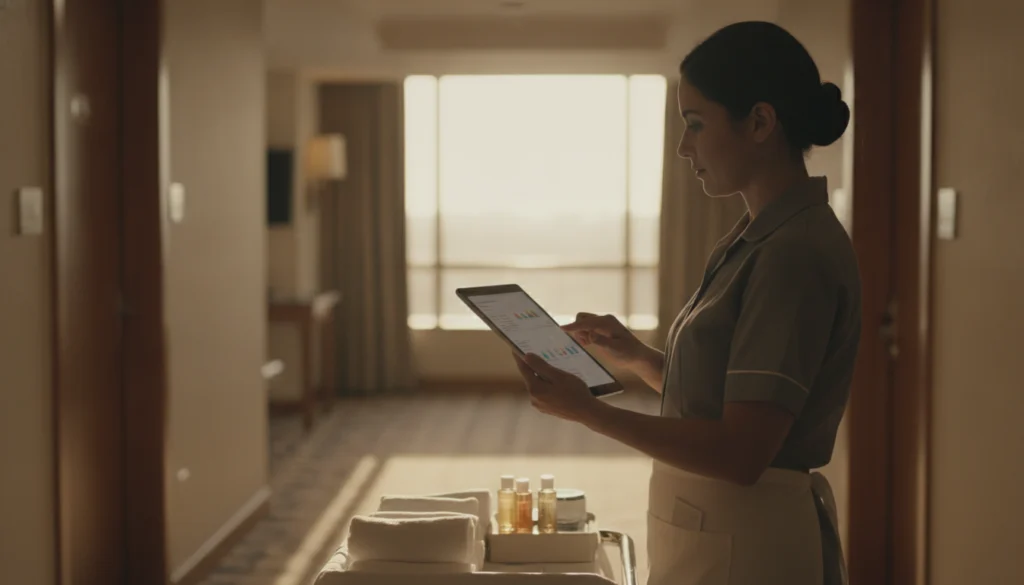
Quick Answer: The best employee engagement platforms for hospitality balance mobile-first survey delivery with action-planning tools, since most hourly staff don’t sit at a desk. Culture Amp, WorkTango, and 5 Starr Engagement each serve a slightly different hotel segment.
Choosing a platform isn’t about picking the "best" tool in the abstract — it’s about matching features to your property size, union status, and language needs.
Matching the Platform to Your Property
A 40-room boutique inn needs something leaner than a 600-room resort with multiple departments. Enterprise HR teams evaluating is Culture Amp a good fit for measuring sentiment typically want deep analytics and benchmarking, which fits better in mid-market and enterprise settings than in single-property hotels.
| Platform | Best Fit | Strength | Consideration |
|---|---|---|---|
| Culture Amp | Mid-market & enterprise HR teams | Deep analytics, benchmarking | Can feel heavy for single-property hotels |
| WorkTango | Mid-sized healthcare & hospitality groups | Recognition + survey combo | Pricing scales with headcount |
| 5 Starr Engagement | Independent & boutique hotels, restaurants, casinos | Hospitality-specific question libraries | Best for teams wanting hands-on guidance |
See our dedicated breakdowns of Culture Amp’s engagement score methodology and Culture Amp pulse surveys for a deeper feature comparison.
💡 Expert Insight: In our work with boutique properties, the platform matters less than the cadence. A simple quarterly survey, consistently acted on, outperforms a sophisticated tool that gathers dust.
What to Look for in Employee Engagement Survey Software
When evaluating employee engagement survey software, prioritize mobile accessibility, multilingual support, and anonymous response handling. Hourly staff won’t complete a 40-question survey on a desktop they never use.
Our own employee engagement surveys are built specifically for hospitality’s shift-based reality, and the 5 Starr Survey format keeps completion time under five minutes.
⚠️ Common Mistake: Rolling out a 50-question annual survey and expecting hourly staff to finish it on a break. Shorter, more frequent pulse checks consistently get better response rates in hospitality.
Build a Frontline Employee Engagement Survey
Quick Answer: A frontline employee engagement survey should take under five minutes, use plain language, and be available in the languages your staff actually speak. Length and complexity are the two biggest reasons hourly workers skip surveys entirely.
I’ve reviewed survey drafts from properties that tried to reuse corporate HR templates word-for-word, and completion rates dropped below 20%. Once the questions were rewritten in the same tone a shift supervisor would use, response rates roughly doubled.
Writing Questions That Hourly Staff Will Actually Answer
Avoid corporate jargon like "synergy" or "value proposition." Instead ask concrete questions: "Do you have what you need to do your job today?" or "Does your manager notice when you do good work?"
For restaurant teams facing similar shift-based challenges, our restaurant employee experience survey uses the same plain-language approach that works for restaurant employee engagement broadly.
Building a Pulse Survey Cadence
An employee engagement pulse survey system works best on a monthly or bi-weekly rhythm, with a longer annual survey layered on top for trend benchmarking. The short pulses catch urgent issues; the annual survey validates longer-term direction.
| Survey Type | Frequency | Length | Purpose |
|---|---|---|---|
| Pulse survey | Monthly or bi-weekly | 3-5 questions | Catch emerging issues fast |
| Full engagement survey | Annually or semi-annually | 20-30 questions | Benchmark trends over time |
| Exit survey | At offboarding | 10-15 questions | Identify root causes of turnover |
| Onboarding survey | 30/60/90 days | 8-12 questions | Catch early disengagement |
Pair ongoing employee pulse surveys with exit surveys for employees and onboarding surveys for employees to cover the full employment lifecycle.

Turn Survey Data Into Action Plans
Quick Answer: Collecting survey data without acting on it erodes trust faster than not surveying at all. An employee engagement action planning template turns raw scores into three to five concrete commitments owned by named managers.
Staff notice when leadership asks for feedback and then nothing changes. That pattern, repeated over two or three survey cycles, teaches employees that honesty isn’t worth the effort.
A Simple Action Planning Framework
- Share top-line results with department heads within one week of survey close.
- Identify the two or three lowest-scoring drivers, not every possible issue.
- Assign one accountable manager per action item with a 30-day check-in date.
- Communicate back to staff what changed, even if the fix is small.
- Re-measure the same drivers in the next pulse cycle to confirm progress.
Our frontline employee retention software guide walks through how to connect this loop to retention metrics directly, and our broader strategies to reduce frontline employee turnover build on the same framework.
✅ Quick Tip: Close the loop publicly. A one-paragraph "you said, we did" email posted in the break room builds more trust than any survey question ever could.
How Engagement Links to Guest Satisfaction
The connection between staff morale and guest reviews isn’t anecdotal. According to the American Hotel & Lodging Association, workforce stability directly supports consistent guest service delivery across properties.
Our earlier research on how employee engagement drives guest satisfaction found that properties with higher engagement scores consistently posted stronger guest review averages over the following quarter.
See How AI Is Changing Engagement
Quick Answer: AI in employee engagement now helps flag disengagement risk through sentiment analysis of open-text survey responses, well before scores drop in a formal review. It’s a supplement to human follow-up, not a replacement for it.
Sentiment-analysis tools can scan thousands of free-text comments and group them by theme — scheduling frustration, pay concerns, management conflict — far faster than a person reading each response manually.
The Limits of AI-Driven Sentiment Tools
AI flags patterns, but it can’t have the follow-up conversation with a struggling night auditor. Properties that rely on AI alone, without a manager actually checking in, tend to see the same issues resurface survey after survey.
According to SHRM, technology should support — not substitute for — direct manager-employee relationships when addressing engagement gaps. As of 2026, most hospitality groups use AI tools for triage and reserve human judgment for action planning.
💡 Expert Insight: Treat AI sentiment scoring as a smoke detector, not a fire extinguisher. It tells you where to look; your managers still have to do the work.
Frequently Asked Questions
What is hotel employee engagement and why does it matter?
Hotel employee engagement is the degree to which staff feel connected, valued, and motivated in their role across all shifts and departments. It matters because engaged teams deliver more consistent guest service and are statistically less likely to leave within their first year.
What are the top employee engagement platforms for hospitality?
Culture Amp, WorkTango, and 5 Starr Engagement are among the most commonly used employee engagement platforms for hospitality, each suited to different property sizes and budgets. Smaller independent hotels often prefer 5 Starr’s hospitality-specific survey libraries, while larger groups may lean toward Culture Amp’s benchmarking depth.
What is the best employee engagement survey software for healthcare organizations?
For healthcare organizations, platforms like WorkTango and Culture Amp are frequently cited as strong employee engagement survey software options, particularly for mid-sized firms needing compliance-aware question libraries. Our medical employee engagement surveys page and our best employee surveys for healthcare guide compare options in more depth.
Is Culture Amp a good fit for mid-market and enterprise HR teams?
Culture Amp tends to fit mid-market and enterprise HR teams well because of its benchmarking and analytics depth, especially for organizations with multiple locations. Smaller single-property operations may find a lighter, hospitality-specific tool easier to roll out and maintain.
How is restaurant employee engagement different from hotel employee engagement?
Restaurant employee engagement tends to focus more heavily on shift-to-shift communication and tip-pool fairness, while hotel employee engagement spans more departments, including housekeeping and overnight audit. Both benefit from short, frequent pulse surveys rather than long annual ones.
How often should hotels run a frontline employee engagement survey?
Most hospitality HR teams see the best results running a short frontline employee engagement survey monthly or bi-weekly, supplemented by a longer annual survey for trend tracking. Shorter, more frequent surveys consistently get higher completion rates among hourly staff than long annual-only formats.
Can small, independent hotels afford employee engagement software?
Yes — many employee engagement platforms, including 5 Starr Engagement, offer pricing tiers designed for independent and boutique properties rather than only large chains. The real cost consideration is usually staff time to act on results, not just the software fee itself.
Final Thoughts
Hotel employee engagement isn’t a once-a-year checkbox — it’s an ongoing cycle of listening, acting, and following up across every shift. Properties that treat it this way see the payoff in lower turnover, stronger guest reviews, and managers who actually know what’s happening on the overnight shift. The tools matter less than the discipline of closing the loop on what staff tell you.
Here’s how to get started:
- Audit your current survey cadence and identify gaps by department and shift.
- Choose a platform that matches your property size, from boutique to enterprise.
- Launch a short pulse survey and commit to sharing results within one week.
- Build a simple action plan with named owners for the top two issues.
- Re-measure next cycle to confirm whether engagement scores actually moved.
If you’re ready to see how a hospitality-specific approach to hotel employee engagement can lower turnover at your property, visit our hotel engagement solutions page and schedule a conversation with our team today.