

Hospitality Personnel Upskilling: Frontline Training & Retention Guide
Hospitality personnel are the single biggest variable in whether a guest returns or leaves a bad review. A well-trained front desk agent or server can rescue a rocky stay; an under-skilled one can sink it. The fix isn’t hiring more people — it’s upskilling the hospitality personnel you already have so they can handle Hospitality 2.0’s faster pace, higher guest expectations, and new technology.
This guide breaks down what upskilling actually means in a hotel, restaurant, casino, or medical hospitality setting, why 2026’s guests expect more, and how operators are using structured feedback and training loops to close skill gaps before they show up on a review site.
📌 Key Takeaways
- Upskilling hospitality personnel reduces costly turnover — replacing a frontline worker can cost 30-50% of their annual salary.
- “Hospitality 2.0” means blending human warmth with AI tools, mobile check-in, and real-time feedback systems.
- Structured pulse surveys catch skill gaps and burnout months before exit interviews would.
- Cross-training frontline hospitality employees on service recovery cuts complaint escalation rates.
- Measurement matters: what gets surveyed gets improved.
Jump to a section:
- What Upskilling Actually Means for Hospitality Personnel
- Why Hospitality 2.0 Demands a Different Kind of Team
- The Business Case for Investing in Your Workforce
- How to Build an Upskilling Program Step by Step
- Tools and Technology Behind Hospitality Upskilling
- Measuring Success With Surveys and Feedback Loops
- FAQ: Common Questions About Hospitality Personnel Training
What Upskilling Actually Means for Hospitality Personnel
Quick Answer: Upskilling means teaching existing staff new, higher-value skills — not just retraining them on the same tasks. For hospitality workers, that usually means service recovery, technology fluency, and cross-department flexibility.
Many operators confuse upskilling with basic onboarding. Onboarding gets someone job-ready; upskilling makes an already-competent employee more valuable over time. Think of it as the difference between teaching a server to take an order and teaching that same server to defuse an angry table without a manager.
Reskilling vs. Upskilling: Know the Difference
Reskilling prepares an employee for a completely different role, like moving a housekeeper into front-desk support. Upskilling deepens capability within the current role. Both matter, but Hospitality 2.0 leans harder on upskilling because guest expectations keep climbing inside the same job titles.
✅ Quick Tip: Start upskilling with your highest-turnover role first. If housekeeping or line cooks churn fastest, that’s where a small training investment pays back quickest.
We’ve seen properties assume a pay raise alone fixes disengagement, only to watch the same employees leave six months later. Money buys short-term loyalty; skill-building and recognition buy long-term commitment. According to the Society for Human Resource Management, employees who feel their employer invests in their growth are significantly more likely to stay past two years.
Why Hospitality 2.0 Demands a Different Kind of Team
Quick Answer: Hospitality 2.0 describes the shift toward AI-assisted check-in, mobile ordering, and real-time guest feedback layered on top of traditional human service. It requires hospitality personnel who are comfortable with both people and platforms.
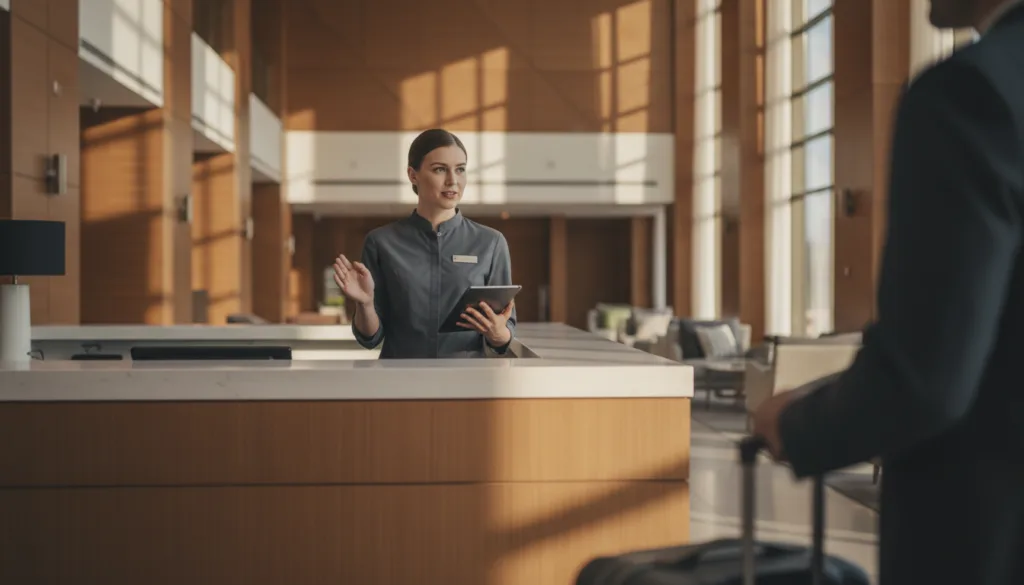
A decade ago, a front desk agent needed a smile and a working knowledge of the property management system. Today that same agent might troubleshoot a mobile key app, pull up a guest’s loyalty history, and still deliver a warm welcome — all within ninety seconds.
The Human-Plus-Technology Skill Stack
Hospitality 2.0 doesn’t replace people with software; it pairs them. Housekeeping staff using digital room-status apps still need judgment calls on guest requests that no app can predict. Restaurant servers using tablet ordering still need to read a table’s mood.
💡 Expert Insight: The properties adapting fastest treat technology training and soft-skill coaching as one combined curriculum, not two separate programs run by different departments.
The American Hotel & Lodging Association has highlighted workforce development as a top industry priority as labor markets tighten, reinforcing that upskilling isn’t optional anymore — it’s a retention strategy in disguise.
The Business Case for Investing in Your Workforce
Quick Answer: Turnover in hospitality remains among the highest of any industry, and every departure costs far more than the paycheck saved. Upskilling existing hospitality personnel is consistently cheaper than constant rehiring.
According to the U.S. Bureau of Labor Statistics, food service and accommodation roles see some of the steepest annual separation rates tracked across all sectors. That churn drags down guest satisfaction scores because new hires simply haven’t built the muscle memory experienced staff carry.
What Turnover Really Costs
Recruiting, onboarding, and lost productivity during ramp-up typically run 30-50% of an entry-level hospitality worker’s annual pay, and considerably more for supervisory roles. Our related breakdown of the national average turnover rate in hospitality shows just how quickly those costs compound across a multi-property portfolio.
📊 Data Point: Properties that pair structured feedback with training investment report measurably steadier retention than those relying on pay increases alone, based on aggregated engagement survey data from our clients.
| Approach | Upfront Cost | Retention Impact | Guest Experience Impact |
|---|---|---|---|
| Rehire & retrain constantly | High (recruiting + lost productivity) | Low — cycle repeats | Inconsistent service |
| Pay raise only | Medium | Short-term bump | Neutral |
| Structured upskilling + feedback loop | Low-Medium | Higher long-term | Consistently improves |
We’ve worked with hotel groups that assumed exit interviews alone would explain their churn. In practice, exit surveys compared with exit interviews reveal skill-gap frustration long before anyone quits — if you’re actually asking the right questions along the way.
How to Build an Upskilling Program Step by Step
Quick Answer: Start with a skills audit, prioritize the highest-impact gaps, deliver short focused training, and confirm progress through pulse surveys. Repeat quarterly rather than treating training as a one-time event.
Step 1: Audit Current Skills
Survey managers and hospitality personnel directly about where they feel least confident — technology, upselling, or conflict resolution are common gaps. Our employee engagement surveys are built specifically to surface this kind of granular, role-level feedback.
Step 2: Prioritize by Guest Impact
Rank gaps by how directly they touch the guest experience. A front-desk technology gap affects every check-in; a back-office scheduling gap affects fewer guests directly.
Step 3: Deliver Bite-Sized Training
Hospitality workers rarely have time for long workshops between shifts. Fifteen-minute pre-shift huddles focused on one skill beat an annual all-day seminar almost every time.
⚠️ Common Mistake: Rolling out a single mega-training session once a year and calling it “upskilling.” Skills fade without reinforcement, and one-off sessions rarely change daily behavior.
Step 4: Reinforce With Recognition
Celebrate staff who apply new skills successfully — a guest compliment tied to a training topic is a powerful teaching moment for the whole team.
Restaurants face a slightly different rhythm than hotels; our guide on restaurant employee surveys walks through how kitchen and front-of-house upskilling needs to diverge.
Tools and Technology Behind Hospitality Upskilling
Quick Answer: Modern upskilling leans on mobile learning modules, AI-assisted coaching prompts, and pulse-survey platforms that catch confidence gaps in real time. Technology should support coaching, not replace it.
Micro-Learning Apps
Short, mobile-first lessons fit between shifts far better than classroom training. Many hotel and casino groups now push a two-minute video before a shift starts rather than pulling staff off the floor.
AI-Assisted Coaching
Some properties use AI tools to flag patterns — like a spike in service-recovery complaints tied to a specific shift — so managers know exactly where to coach next. Our team explores this shift in more depth in our piece on AI and hospitality upskilling.
💡 Expert Insight: Technology surfaces the problem; a human manager still has to deliver the coaching conversation. Skip that step and the data goes to waste.
Medical hospitality settings — think concierge medicine or long-term care front desks — face their own version of this challenge, which is why medical employee engagement surveys ask very different questions than a casino floor survey would.
Measuring Success With Surveys and Feedback Loops
Quick Answer: You can’t upskill what you don’t measure. Regular pulse surveys and follow-up check-ins tell you whether training actually changed behavior on the floor.
Set a Baseline First
Before launching any training, survey hospitality personnel on confidence levels in key skills. This baseline is what you’ll compare results against three and six months later.
Track Leading Indicators, Not Just Turnover
Turnover is a lagging indicator — by the time it moves, you’ve already lost people. Confidence scores, guest complaint categories, and manager feedback shift much sooner and give you time to act.
✅ Quick Tip: Ask one open-ended question every quarter: “What’s one thing you wish you were better trained on?” The answers are often more useful than any formal skills matrix.
Burnout and skill gaps frequently travel together. If your team is stretched thin, no amount of training sticks — our article on burnout in the hospitality industry is worth reading alongside any upskilling plan. Likewise, our frontline staff retention research shows engagement scores predict departures well before an exit interview happens.
As of 2026, more operators are running quarterly pulse checks instead of a single annual engagement survey, simply because the pace of change in guest expectations no longer allows for a once-a-year check-in.
FAQ: Common Questions About Hospitality Personnel Training
What does upskilling hospitality personnel actually involve?
It involves teaching current staff new or deeper skills — like service recovery, technology fluency, or cross-department flexibility — rather than simply retraining them on existing duties. The goal is higher capability within the same role, not a full career change.
How is Hospitality 2.0 different from traditional hospitality training?
Hospitality 2.0 blends traditional guest-service skills with comfort using mobile apps, digital check-in, and real-time feedback tools. It assumes hospitality personnel can move fluidly between human warmth and tech-enabled service moments.
How often should hospitality teams receive upskilling training?
Most successful programs use short, frequent sessions — often weekly pre-shift huddles — reinforced by a formal review every quarter. Annual, one-time training sessions rarely change daily behavior on their own.
What’s the fastest way to identify skill gaps in hospitality staff?
A well-designed employee engagement or pulse survey asking staff directly where they feel least confident is faster and more accurate than manager assumptions alone. Following up with targeted coaching closes the loop.
Does upskilling hospitality personnel actually reduce turnover?
Evidence suggests it does, because employees who feel invested in tend to stay longer than those who only receive a pay adjustment. It won’t fix every retention problem alone, but it removes one common reason people leave: feeling stuck.
Can small independent restaurants or hotels afford an upskilling program?
Yes — bite-sized, low-cost training like pre-shift huddles and peer coaching costs far less than constant rehiring. Even a simple quarterly survey can guide where limited training budgets should go first.
How do you measure whether hospitality upskilling is working?
Track leading indicators like staff confidence scores, guest complaint categories, and manager feedback rather than waiting on turnover numbers alone. A baseline survey before training, compared to a follow-up survey after, shows measurable change.
Final Thoughts
Hospitality personnel are the engine of every guest interaction, and Hospitality 2.0 simply raises the bar on what “skilled” now means. Operators who treat upskilling as a continuous, measured process — not a once-a-year event — see steadier retention and stronger guest scores. The tools exist; the missing piece for most teams is a reliable feedback loop that tells them exactly where to focus next.
Next steps:
- Run a baseline engagement or pulse survey to identify current skill confidence gaps.
- Prioritize training around the roles with the highest turnover or guest-facing impact.
- Deliver short, frequent coaching instead of annual workshops.
- Re-survey quarterly to confirm the training is changing behavior, not just checking a box.
Ready to find out where your hospitality personnel need support most? Book your engagement survey with 5 Starr Engagement today and start building a Hospitality 2.0-ready team.